Transcript
Brian: Just an update before we start this episode. Since recording this podcast earlier this year in 2025, there have been some significant developments in the greyhound racing industry in Australia, including the announcement that Tasmania will phase out greyhound racing by July 2029, and Western Australia is currently holding a parliamentary inquiry into greyhound racing, which is expected to provide a report in 2026.
Debbie: Since 2020, a total of 857 dogs have actually been killed on the race track, and the leading causes of these fatalities have been single bone fractures and multiple bone fractures.
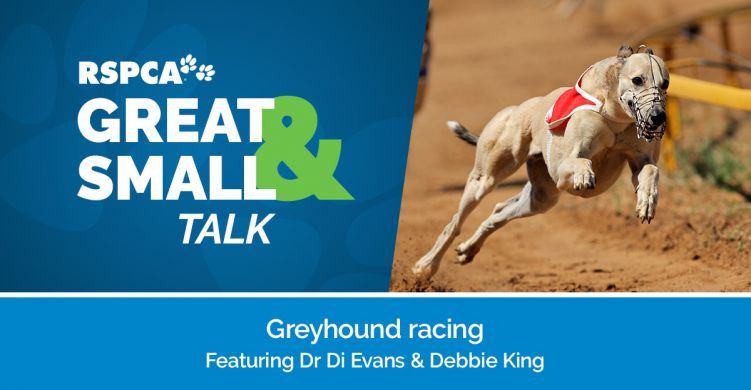
Brian: Hello and welcome to RSPCA Australia's Great and Small Talk, where we discuss the pressing welfare issues animals face in Australia. I'm Brian Daly, and today I'm joined by Dr Di Evans, Veterinarian and Senior Scientific Officer at RSPCA Australia, and Debbie King, Animal Welfare Policy Officer at RSPCA Western Australia, to discuss the welfare issues associated with greyhounds in the racing industry. Diane, Debbie, welcome to the podcast.
Di: Thanks, Brian.
Debbie: Thanks, Brian, good to be here.
Brian: Now the greyhound racing industry has been mired in controversy for years, with documented evidence of gross mistreatment of animal servicing with distressing regularity, yet it still persists, and is a sizeable industry operating in nearly every state of Australia. Di and Debbie, could you give us an overview of the greyhound racing industry in Australia today?
Di: It might be a good idea just to sort of step back in time. So the racing of greyhounds began in the late 1800s across Australia, and this basically involved a live animal being released to be chased by dogs across a paddock. And then changes were made in the early 1900s and this really formed the basis of the beginning of what we see as greyhound racing today, which is conducted in all states and territories, except for the ACT, where it is actually banned. So this early version was called tin hair racing, and involved dogs chasing a mechanical lure around a circuit. And today there are 1000s of dogs raced with over 60 tracks across Australia and with most of racing occurring in New South Wales, Victoria and Queensland.
Brian: And how does that industry compare to, say, what's happening in other countries?
Di: Well, interestingly, there's very few countries that permit commercial greyhound racing, with the sport actually being restricted to the United States, United Kingdom, Sweden, Denmark, Germany, the Netherlands, Mexico and Vietnam. So on a global scale, that's a very small number of countries. And in fact, there's actually been a huge decline in the industry worldwide through pressure from animal welfare and community groups, not just due to cruelty concerns, but also the negative societal impacts associated with gambling. And interestingly, in December last year, the New Zealand government announced that, due to ongoing serious welfare concerns, greyhound racing would be phased out, with the end date being July next year. And this has also been followed by an announcement in February this year that greyhound racing will cease in Wales. And this is really significant, because in the UK, greyhound racing was a huge draw card for families. But over recent years, there's been a massive decline, with 60% of the tracks having closed, and in the USA, the sport has been banned in 44 states, and there's currently only two operational tracks, both of these are in West Virginia, and even the track owner wants to see the end of greyhound racing. So this is a far cry of nearly 70 tracks across 19 states in its heyday in the US. But the other thing that's happened, and this is just in May this year, a media article reported an open letter by over a dozen US politicians urging their Australian counterparts to phase out greyhound racing in Australia, citing significant animal welfare issues, but also the benefits arising from repurposing race tracks, they see potential in having these available for open parks, community hubs, housing and music venues and so on. But the other thing about what's happening in the US is that seven states have outlawed remote wagering on greyhound racing, and this includes races held in Australia, and we expect to see more states to follow on this. One of the things that really underpins the greyhound racing industry in Australia is online betting.
Brian: So the industry is sort of declining, as you say globally. What about the greyhounds themselves? How and from what age are they raced and trained?
Debbie: So the greyhounds actually start training a relatively young age. So from about 6 to 12 months, they'll start off with the more basic preparation training, so general handling exercise, usually from about 12 months of age, they'll then start the more race-specific training. So that would involve training them to chase the lure around the track, and also going through starting box practice, so when they enter the box at the beginning of the race, teaching them how to make a clean break from the race to give them the best possible start. Then the actual racing greyhounds are only permitted to start their racing career at 15 months of age under the Australasian rules of racing, and then, generally you'll see most greyhounds commence their racing career at around 18 months of age.
Brian: And how long are they expected to last in this industry?
Debbie: The average retirement age is estimated to be around three and a half to four and a half years of age. So that means the average racing career generally spans only about one and a half to two and a half years, and they generally will retire if they're injured or if they're not very successful on the race track.
Brian: And what happens to those young greyhounds who aren't fast enough or successful?
Debbie: Yeah, and that's actually a really good and pertinent question, because one of the key concerns we have is the lack of clear or consistent data around what we would call a utilisation rate, so the number of greyhounds that are being bred versus the number that actually reach the racetrack and have a racing career. So while breeding numbers are often reported by the different racing jurisdictions, there is limited transparency on how many of those dogs actually commence a racing career. And we also see large numbers of young greyhounds, usually under about two years of age, that still require rehoming because, you know, during the training, they've shown that potentially, they're not going to be a particularly successful racing dog. So you see these, you know, streams of young dogs that aren't going to make it as racing dogs, and combined with those dogs that have had racing careers and are retiring for whatever reason, whether it's injury or they've just reached an age where they're, you know, they're past their peak. So you get these two streams of dogs that are going to require homes, and that puts a lot of pressure on the rehoming groups, the industry, rehoming organisations, which are known as greyhounds as pets, and that's really starting to cause issues with with the volume and the number of dogs that need homes versus the number of homes that are actually available.
Brian: Yeah, because the industry breeds a lot of dogs and never race them, as you say, if they don't show any potential. Why is this so, and how, what can be done to resolve it?
Di: This is a hugely important issue that really affects the social license of the industry. And currently, breeding numbers are based on ensuring that there's sufficient dogs to fill each race, and this averages about eight dogs a race, with this being the key objective. And we do have some estimates of approximately 40% never racing. This means that nearly half the dogs bred will never race, and so the industry has no need for these dogs. And this is often referred to as wastage.
Brian: So what happens to these wasted dogs?
Di: This is an issue that has to be resolved. This is, this is really up there, and there's several things that they can do. So first thing is that they ... the industry has to introduce a breeding cap so that they're reducing the number of pups being born and ... but the thing about this is, if you've got less pups going into or less dogs going into the industry, you're either going to have to reduce the number of dogs per race, or you're going to have to reduce the number of races. And this is a problem because these measures may affect the ongoing viability and profitability of the industry, and so using this approach is likely to be rejected by the industry. But what's really disturbing is that not only is the industry not capping breeding, but there are several breeding incentive programs which will see more pups born, thus exacerbating the wastage issue. But the other part, and what's really key to all of this is that breeding numbers have to be based on the number of dogs who can be rehomed, not on the numbers to be able to fill racing programs. And we believe that this is a crisis, as the potential homes, as Deb alluded to earlier, are being saturated. So continuing this high level of breeding is not sustainable, and it's really important that the industry has to be able to demonstrate that every dog who is retired goes to a loving home for the rest of their life. The other part of this is the early retirement of dogs through injury, and that's another big issue that the industry must address.
Brian: What happens to these retired greyhounds, including, as you say, these, these ones that are prematurely deemed to have finished their career?
Debbie: Ideally, greyhounds, even if they've had a relatively long career, so that they're retiring after about four years of age, ideally, and hopefully, they transition to life as a loved pet, and that can happen through generally, one of three avenues. So the industry, as I mentioned before, have their own rehoming organisations, known as greyhounds as pets, and they facilitate and work with industry to take retired greyhounds and facilitate that adoption process.
There is also the option of third party adoption, so that involves the owner or greyhound trainer facilitating an adoption themselves, or keeping the animal and themselves as a pet. And then there are a whole host of other voluntary and community organisations that really do bear quite significant brunt of the rehoming pressure, although it's really important to point out that, you know, that is an ideal situation for most greyhounds, and unfortunately, one of the inherent problems with greyhound racing is injuries. So that's usually how many greyhounds will end their career because of a career ending injury.
Greyhounds are very susceptible to a wide range of different types of injury, ranging from the minor, like things like lacerations, muscle strains, sprains, but then we see a lot more significant to catastrophic injuries, so things like multiple bone fractures, spinal injuries, internal bleeding. So it's definitely one of the biggest things that, you know, we have concerns around.
And another issue with this is obviously the data. So at present, there's one greyhound advocacy group that have put a huge amount of work into collating greyhound fatality and injury data on a national level, and at the moment, their data is the only source of national data that exists that's been collated. So the organisation, the Coalition for Protection of Greyhounds, have provided this data, and we've done some, really at the moment, quite basic analysis on it. But it shows so far that since 2020, a total of 857 dogs have actually been killed on the on the race track, and the leading causes of these fatalities have been single bone fractures and multiple bone fractures, and these injuries have accounted for 83% of these 857 fatalities. So that's quite a shocking statistic, and 68% of these fatal injuries were actually caused by the greyhounds colliding with each other during the race.
So again, it points to, you know, the inherent issues in the design of greyhound racing and how that really predisposes these dogs to some really significant and quite horrific injuries. And these are just the fatal injuries. So another important data set that the Coalition for Protection of Greyhounds is is also collecting, and this is a fairly new data set, and it's only been going since November 2024 but it's actually looking at the more serious and severe injuries that require what the industry call a stand down period of 60 days. And that stand down period is a mandated break from racing. So the greyhound isn't actually allowed to race for that minimum 60 days, and again, the types of injuries that we're seeing are, you know, serious bone fractures, multiple fractures. Generally, we're seeing around 60% of these serious injuries involve a fracture of some kind or description.
Now, in terms of the injury reporting, this is obviously based on data that the Coalition for Protection of Greyhounds has provided, and that data actually comes from the steward's reports, which are published after every single race meeting, and they are publicly available, but it's very painstaking work to go through those reports and pull out all of the relevant data. Now each racing authority in every jurisdiction does also report in a slightly different way on the injuries, and generally that data, or overall results of that data, can be found in their annual report. And we've also been doing some analysis on that, and they categorise those injuries from very minor injuries through to deaths and euthanasias that happen on the track. And over the past five years, they've started to include a category called ‘Category F’, and this combines the deaths and euthanasias on the track with the most serious injuries. So again, we're talking single or multiple bone fractures, spinal injuries, serious trauma.
And actually analyzing that data over the last five years shows that really in every jurisdiction, there is either an upward trend or it's holding steady. So it goes to show that despite every jurisdiction putting quite significant amounts of money into things like track safety, track design, it's really not having a significant effect on the worst injuries and also the fatalities.
Now, there are other avenues that the racing authorities have tried to explore to try and deal with the amount of injuries that they're seeing, and also to try and reduce the number of euthanasias that are happening on track. And these are in the form of various different rehabilitation and injury recovery schemes. So these schemes, they differ between state but they basically provide financial support to owners and trainers for the cost of veterinary treatment, surgery, rehabilitation for injured greyhounds, and in some situations, these schemes have actually also involved the racing regulator taking ownership of those injured dogs and overseeing their recovery and treatment themselves, and then hopefully overseeing their their rehoming.
Now, on the face of it, that seems like a fantastic idea, and obviously we are very supportive of any kind of scheme that that helps to provide treatment for a greyhound that gets injured on the track. However, there are some issues that occur with these rehab schemes, because we end up seeing injured greyhounds that are within, you know, gap programs, sitting in kennels for long periods of time whilst they're undergoing their treatment and rehab. And this can create a bottleneck on an already quite strained situation with greyhounds needing to be re homed.
So we have these injured greyhounds that are taking up space, and then we have other greyhounds that are otherwise healthy and ready to be rehomed. And there's that competition for space, and it creates a bottleneck, so it can have an impact on the rehoming process for healthy dogs. We've also seen the issue of dogs that potentially are being raced for longer because these schemes are actually do exist.
The owners or trainers maybe see that they have some sort of like exit strategy where the cost isn't really going to have to be footed by them if the dog does get injured, and in particular when these schemes have involved, being able to transfer ownership of these dogs over to the racing authority. They see it as a bit of an exit strategy. So, you know, there are so many inherent problems that need to be addressed, and even with these rehab schemes, it doesn't seem to be something that is really having a lot of success in addressing the issue of injuries in greyhound racing.
Brian: Yeah, so we've got the consequences of over breeding, and we've got these horrific injury stats from racing itself. Are there any other welfare issues that greyhounds are facing in this industry?
Di: In addition to dogs dying on the track and the huge number of non-fatal injuries, there's also fatalities and euthanasias that occur off the track. So the on the track ones are reported, but the dogs that are there are a number of dogs who are euthanased later as a result of an injury incurred during racing or while they're training or doing trialing, that sort of thing, and these are not reported in all jurisdictions. So in 2024 data from racing steward reports showed that 128 greyhounds across Australia died on a race track. But we know that this is an underestimate, but due to lack of proper reporting, we actually don't know what the real numbers are. So we don't know if this figure could be doubled or whatever. So this is a massive gap.
The other really important area to look at are the impacts associated with how greyhounds are reared and cared for. So for the life of many greyhounds, and I'm talking about racing greyhounds, it just consists of being maintained, usually on their own, in a kennel, and this is just basically like a big wire cage with a concrete floor. The sad thing is, we've also seen some dogs being kept in tin sheds with little or no protection from hot or cold temperatures. But the big thing is that these kennels lack enrichment for greyhounds to express their natural behaviors and or participate in pleasurable activities. And we all know that being able to do this is vitally important for their mental health.
And you know, sadly, the only time they get to leave the kennel is to train or to race, and on the whole, they never get the opportunity to mix with dogs of other breeds, and this interaction is really key as part of their proper socialisation, which then provides a foundation for them to transition smoothly into being rehomed. So they also miss out on normal day-to-day encounters that companion dogs have, such as learning to be comfortable around noise, new people, and the other big problem is that they're not house trained, and this can be really challenging when they're adopted.
So put simply, it's clear that more needs to be done to ensure that racing greyhounds are socialised properly, are housed comfortably, and are provided with appropriate enrichment for mental health.
But I'm going to change tact here and go to something which is even more disturbing, and that's live baiting. Look, this is an abhorrent practice that's occurred over decades, involving many members of the industry, including high-profile trainers, as revealed by the ABC four corners program in 2015, "Making a Killing." And this exposed the extent of live baiting in Queensland, New South Wales and Victoria. Now, live baiting involves using small animals such as rabbits, possums and even kittens being attached to a lure to encourage dogs to chase and attack. And this is often referred to as "blooding dogs", and it's the aim is to sharpen their predatory instincts so that they run faster and then presumably, will win more races.
Now, even though this is illegal in all jurisdictions, it's this law is not adequately enforced, and we continue to see cases being uncovered, and I'm sure there's more that goes on that aren't uncovered as well. So unless it can be clearly demonstrated that this practice has stopped, this issue does pose a significant risk to the social license of the industry in the future. In other words, community acceptability or greyhound racing depends on the industry demonstrating that animal welfare is first and foremost, and this includes a guarantee that no live baiting is occurring. That's absolute.
Brian: Are there any other issues that are pressing within the industry?
Debbie: Yeah, there's, there's definitely another one to know, and that's what's termed as "doping." So that is the administration of prohibited substances to racing greyhounds, and these substances might be things like performance enhancing drugs like caffeine, amphetamines, cobalt, pain killers and anti-inflammatories so to mask any injuries and allow a dog to continue to race. And sedatives and tranquilisers. So these might be used for, you know, to slow a dog down and to try and rig the outcome of a race. And we know that this is still happening because the industry themselves have to report on this, and a couple of the jurisdictions. So, for example, the Queensland independent regulator for greyhound racing in just in 2024 last year, actually reported 10 doping incidents in a single month, and these led to fines and suspensions for the trainers. And then in South Australia in their annual report in financial year 2022, they indicated that just over 1% of the 1,800 drug tests that they'd carried out returned positive results for prohibited substances. So, you know, this is an issue that the industry itself are aware of, and actually are reporting on.
Di: The other really important issue that needs to be mentioned, and actually was the focus of the federal inquiry a few years ago when an amendment was put forward, and this relates to the export of racing greyhounds to other countries. So firstly, the RSPCA is opposed to the export of racing greyhounds due to the welfare risks, including things like stress, injuries associated with long distance transport. We also have concerns about lack of animal welfare protection in terms of laws and legislation in importing countries, and due to the lack of formal tracking system for dogs exported to other countries, we don't actually know what happens to them after racing. It's like ... they leave Australia, and that's the last we really hear of them. So, and this is a really serious concern, in addition to the apparent lack of formal rehoming and adoption programs in some of these destination countries. So, yeah, this, this is another really big issue.
Brian: You mentioned the authorities that that regulate the industry. Who are these authorities that oversee the practices?
Debbie: The greyhound racing industry in most states in Australia is what we would term as self-regulated. So they basically have their own rules, their own methods of enforcement, and then their own penalties or sanctions for breaking those rules. And the issue is that those racing authorities are also responsible for promoting the racing industry as well, so there's quite a clear conflict of interest. New South Wales and Queensland are the exceptions to those they do both have independent regulatory bodies that oversee animal welfare and racing integrity, and they're separate from the industry. And at the moment, there's actually a major inquiry that's actually happening as we speak, into Greyhound Racing New South Wales, and that's being undertaken by the New South Wales independent regulatory greyhound racing body, and that inquiry is actually focusing on some serious animal welfare issues that have been raised, such as high fatalities on the track, high levels of injury, and also rehoming statistics that they, you know, people have raised and basically have doubts about their accuracy. So it will be really interesting to see what the outcome is of that report, and that could really have quite a major influence on the greyhound racing industry in New South Wales and also across the country.
Brian: And there's been other inquiries previous to this for years now. And as you mentioned, Di, there was the you know, there's incidents reported in ABC programs and the like. Have these inquiries done anything to improve the practices over the years?
Di: Well, look, nearly every state and territory has had some form of inquiry or review in the last 10 years or so, and just the mere fact that so many of these reviews are occurring reflects that there's acknowledgement of the inherent animal welfare issues associated with Greyhound Racing, as well as increasing community concern. The most significant inquiry to date has been the one held in New South Wales following the shocking revelations from the ABC Four Corners program on live baiting 10 years ago. The resulting McHugh report released in 2016 was very damning of the greyhound racing industry in New South Wales, and this led to the then Premier, Honourable Mike Baird to call for a ban. But this wasn't supported at ... at that time. Instead, a government-funded independent body was set up to oversee greyhound racing to try and, I guess, encourage more transparency, accountability and therefore trust and confidence in what the industry was doing. But more recently, a review in South Australia in 2023 likewise, was also damning of the industry, and this has led to the government putting the racing industry on notice and giving them two years to implement key recommendations. But at this stage, we're yet to see what progress has been made. So, in a nutshell, despite numerous reviews, it is really difficult to identify tangible improvements to the lives of greyhounds being used in breeding, racing and after retirement, and this is really due to a lack of accountability and transparency. Some efforts have been made to improve track safety, but these appear to have failed in terms of reducing injuries and deaths, and we continue to see a lack of publicly available reporting on all deaths, and this includes numbers and circumstances at every life stage for each greyhound born into racing. And, there's also huge concerns regarding the fate of greyhounds leaving the industry. So there is no tangible evidence that every greyhound who leaves the industry has a good life for the remainder of their life.
Brian: So what needs to happen? I mean, what's the RSPCA's stance on this? What should happen to the racing industry?
Debbie: There's no question that the greyhound racing industry is coming under increasing scrutiny from the general community, and its social license really is eroding at quite a rapid rate, and we have the data to back this up. So, RSPCA have actually commissioned independent surveys for the last 10 years, which shows that 75% of Australians are concerned, or very concerned, about the welfare of racing greyhounds, and this is really significant, because really without the trust of the public, it will be very difficult for the industry to sustain itself long term, so they really need to put significant efforts into ensuring that greyhounds have a good quality of life at all stages, and that they have the clear, transparent data to back that up.
Brian: So everything around the world is pushing towards ending this industry. Everything in Australia is pushing towards ending this industry. All the inquiries are showing that the industry is not working. We've tried to improve the industry. It hasn't worked, but it's still going to continue for some time until that is eked out. So what needs urgent addressing while this industry still continues?
Di: Well, there's three really important areas that should be addressed as priorities, not only because they're really significant in terms of animal welfare impacts, but also in relation to community expectations, and this is obviously going to have a huge influence on dictating the future of greyhound racing. So the first one that needs ... that more needs to be done is to significantly reduce injuries and deaths, and that all injured greyhounds receive high standards of treatment and rehabilitation. And as part of this is that there's got to be much better reporting in terms of all injuries and deaths in all circumstances. The second one is that there has to be a cap on breeding greyhounds to significantly reduce the number who are unwanted by the industry, so full responsibility lays with the industry to ensure that every suitable greyhound will be rehomed upon retirement, and that provisions must be made to ensure their wellbeing after racing. And the third area is self-regulation, where, unlike any other industry, it's fair to say that the racing industries, including greyhound racing, are essentially self-regulated across most Australian jurisdictions, and this needs to stop. There must be independent third party scrutiny and regulation of the industry. And in addition to this, national greyhound welfare standards must be developed and regulated under animal welfare legislation in every jurisdiction, rather than the industry imposing weak penalties such as suspensions or small fines, perpetrators must also be prosecuted under animal welfare legislation to help ensure that penalties act as effective deterrence. At the moment, you know, it's almost a slap on the wrist, and yeah, you're free to go. This is ... this really needs addressing.
Debbie: Following on from that, Di, the ensuring that there is the level of investigation and surveillance for things like live baiting and serious offenses, and that there are strong penalties, as with increased checks for banned substances and doping, because obviously, at the moment, it just seems that the penalties just don't really fit the crime, so to speak. So it's not acting as a strong enough deterrent.
Brian: We've mentioned through this discussion, we don't really know what happens to these dogs once they get out of the industry. So how can we improve that? How can we improve that traceability?
Debbie: Yeah, that's a really good point, and we desperately need an effective national identification and traceability system for all greyhounds, and that's not just when they're racing, but literally from birth through to the end of their life. And that data needs to be really comprehensive. So it needs to be life cycle data that records, you know, at various touch points throughout the greyhound's life. And that data needs to be really robust, and the integrity of it needs to be checked, because, coming back to the industry that is largely self-regulated, that goes for the data that they're choosing to collect and make public as well. So there needs to be systems that are implemented that ensures that that data is really transparent. It's independently audited, and there isn't this reliance on self-reporting.
Di: I just thought I'd finish up on a couple of issues. The first one is the big concerns regarding these third party adoptions for dogs who aren't say rehomed through the formal programs, but instead, the industry participants arrange for rehoming. So what's really important in terms of improving accountability and transparency is that there must be full details reported on the process, and there needs to be followed up inspections to ensure that these dogs are in good condition and are being well cared for as a companion animal in a loving home.
The other part, as I mentioned earlier, about the export of greyhounds to other countries for racing, we've ... we've seen a really concerning recent development, actually, involving the importation of racing greyhounds into Australia from New Zealand. And this is really concerning, especially as we've already seen 80 greyhounds being imported into Queensland, and we are really concerned that that more are likely to follow. So when the New Zealand government announced the phase out of greyhound racing at the end of last year, the intention was for all of those greyhounds to be rehomed in New Zealand. Unfortunately, legislative changes weren't introduced quick enough to prevent racing greyhounds from being exported out of New Zealand. So we've already got one trainer who has transferred his business to Australia.
And what we would like to see is that racing authorities who have the power to reject these imports to do so, and there's many good reasons for that. First of all, bringing more dogs only adds to the stretched rehoming programs, and these dogs have now been denied, or will be denied the opportunity to directly transfer into a loving home in New Zealand. Instead, they'll have been, or could be, transported to Australia to be exposed to ongoing risks of injury and death, as well as having an uncertain future. So overall, I think it's pretty clear that there are many inherent serious animal welfare issues which continue to plague the greyhound racing industry, with some appearing to be insurmountable, and the spotlight is firmly focused on if and when the industry can resolve these effectively. What is clear is that the social license of this industry depends on substantial changes being made to safeguard the welfare of greyhounds and to ensure transparency and accountability at every stage for every greyhound born, and especially after racing, so that they're able to live a happy and healthy life.
Brian: It's an industry absolutely fraught with animal welfare issues and concerns, so I really thank you for your time today, Di and Debbie to bring us up to speed with with what's going on in the industry today in Australia, and I mean, in a country that supposedly loves dogs, it's really hard to fathom how this industry is still able to operate. And let's hope we can see the welfare of these animals finally be considered more important than profit. Thanks again.
Di: Thanks. Thanks, Brian.
Debbie: Thanks, Brian.
Brian: We've been talking today with Dr Di Evans, Veterinarian and Senior Scientific Officer at RSPCA Australia, and Debbie King, Animal Welfare Policy Officer at RSPCA Western Australia. If you would like any more information on the welfare issues in the greyhound racing industry, you can visit the RSPCA website at rspca.org.au. You can also subscribe to the podcast series at the website, or all the usual podcast suspects. I'm Brian Daly, and I look forward to your company next time on RSPCA Australia's Great and Small Talk.