Transcript
Gemma: Basically it comes down to knowing how cats communicate, knowing what they need. If caregivers have a good understanding of those things, it makes it much easier for them to provide an environment that optimises their cat's welfare.
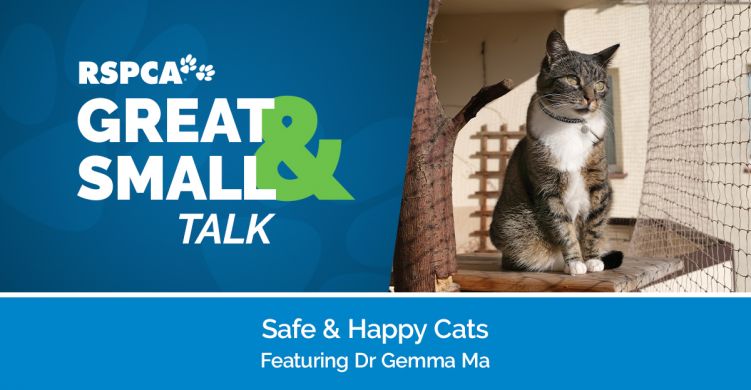
Brian: Hello and welcome to RSPCA Australia's Great and Small Talk, where we discuss the pressing welfare issues animals face in Australia. I'm Brian Daly, and today we're revisiting a topic that is of great interest to many Australians, and that's how to keep cats safe and happy and healthy. And to give us the rundown on exactly how to do that, I'm joined by RSPCA New South Wales Senior Manager of the Keeping Cats Safe at Home Program, Dr Gemma Ma, welcome back to the podcast, Gemma.
Gemma: Thanks, Brian, it's great to be back.
Brian: Now with one in three households in Australia owning a cat and an estimated 5.3 million lovable moggies living in those households, this is an important issue, especially when people may have different ideas on how to best care for them. And for some this includes allowing them to roam. And we know from our previous discussions that the RSPCA encourages people to keep their cats contained at home. Gemma, can you first explain to listeners what we mean by a roaming cat versus a contained cat?
Gemma: Yeah, so when we say contained, we mean prevented from roaming away from the caregiver's property, so prevented from crossing roads, prevented from entering neighbors' houses and gardens, prevented from roaming into wildlife protection areas or national parks. It doesn't necessarily mean prevented from enjoying the outdoors, but because cats are very agile, they can jump or climb over most regular fences, providing safe outdoor access or safe access to outdoor spaces that prevent cats from roaming does require a bit of extra thought and potentially some modifications to the home or to fences.
Brian: And what are the biggest risks to cats that are allowed to roam?
Gemma: I guess the big one is being hit by a car. Lots of cats are hit by cars every day, and it's really sad. Cats can also be attacked by dogs, and they can get into fights with other cats. They're definitely at risk of infectious diseases as well. So the ones we think about are Feline Immunodeficiency Virus and feline leukemia virus. So those are spread by fights with cats, predominantly through bites. They're also at risk from deliberate harm. So there's a lot of people who don't like cats in Australia, and we do see that a lot through our inspectorate, for example, where people are deliberately cruel to cats and can really hurt them or kill them. Cats can also get lost. They can get stolen. They can ingest poisons, and rat bait is probably the biggest one when it comes to poisons. Sometimes that's deliberate as well, and the unique risks that we face in Australia are snake bites and tick paralysis, which can be very, very dangerous for cats as well.
Brian: Yeah, and I guess they can increase the risk of getting impounded as well.
Gemma: Yeah. That risk kind of varies from council area to council area, depending on what councils do, but certainly that can be a risk in some areas as well.
Brian: With all those dangers around the average lifespan would be affected as well, I'd imagine.
Gemma: It's tricky to say we don't have good data on life spans between roaming cats and contained cats, and certainly cats that do roam can live long lives as well. But what we ... from the data that we do have, it looks like cats that do have free outdoor access, that can roam freely, probably have a life expectancy somewhere around four to five years on average, compared to a cat who lives fully contained or indoors that might live for 14 or 15 years. So something like a 10 year difference, if you look at that average. And the sad reason that that average is so different is because so many cats that die in accidents from roaming outdoors, will die when they're young. So it's kind of the cat will, will will learn to cross the road or or they'll die in the process of learning.
Brian: Yeah. And you mentioned about the possibility of them roaming into wildlife areas or national parks. What do we know about the impacts of roaming pets on these areas or local wildlife?
Gemma: Yeah, I guess from the narrative that we hear in the media, you might think we know more than we actually do. So actually, don't know that much about the impacts that cats have on wildlife populations. We certainly know that cats are highly motivated to perform predatory behaviors. So even when they're well fed, they're very motivated to chase things, to catch them, to kill small animals. And it's not just about being hungry. We also know most cats, including owned cats, will hunt if they're given the opportunity to do so. We also know that many of the prey items that that cats will consume, especially cats that are living around people, are the introduced species like rats and mice. But there are some Australian native species that are really susceptible to cat predation as well. So those are especially the smaller mammals, so under about two kilos. So thinking things from like a ring tail possum and smaller and also some birds, smaller birds and reptiles and amphibians as well that can be really susceptible to cat predation. So population level impacts of cat predation on wildlife species probably really depend on the location, and this intersects a lot with many other threats to biodiversity, especially habitat destruction and human activity. So where cat predation is probably particularly important are where we've got small remnant areas of wildlife habitat that are fragmented and they're surrounded by new residential developments, and then we probably do get this kind of halo effect. We've got owned cats who roam into those areas. They scare the wildlife. They might hunt them and kill them. So we do probably have threats in those areas where we have high densities of cat populations that are owned, and just because there's so little habitat left for those wildlife to to be safe in. We also know that cats and owned cats prefer to roam into those natural areas rather than staying in the suburbs. They'll preferentially go into the bush.
Brian: Right, right. And so there are differences between urban, suburban and rural expectations around roaming cats then?
Gemma: There definitely are, I think, for a range of different reasons, and the impacts that they might have on biodiversity are probably different as well, like there are probably less ... less cats in those areas, potentially, but probably roam more, we certainly have this norm around having barn cats in rural areas. So people might still have their house cats that they keep in a similar way to the way other people might keep cats in the suburbs, but they might also have these outdoor cats who have a job to do. You know, they're catching the rodents, they're controlling the mice in the barns, doing an important job. I guess there's also less concern about impacts on neighbors of roaming cats in rural areas, because people are more spread out, and there seems to be a ... we've certainly found this in our research, that there's less perception of risk in rural areas, which might not necessarily reflect the reality. I guess if you're living on a property away from the road, you might think the risk of your cat being hit by a car is less, but actually we find cats in rural areas are more at risk of being hit by cars, and things like snakes, of course, are probably more of a risk to those cats too. Certainly, what we do see is that in rural areas there's more intersection with feral populations, and those communities tend to have different expectations about how cats are managed, because I guess they're more familiar with the ... with the various management approaches to feral cats in those areas.
Brian: And so, you know, the topic of cat containment has been getting a lot of attention recently, and so can you tell us why that is?
Gemma: It's certainly been a hot topic recently, and it's quite politically popular. It kind of brings ownership expectations in line with what's required of dogs. So it feels like a familiar concept, and feels like it should be the same between cats and dogs, which is not necessarily valid. Cats and dogs are very different species, and we have very different relationships with them. And I guess one of the reasons it's such a popular political idea is that it seems at face value like it's going to solve some of our challenges with cats. So we know that lots of people are concerned with the nuisance aspects of roaming cats, cats pooing in people's yards and bothering their dogs and cats. And, you know, cats predating wildlife, are things that seem like they could be solved by mandating containment. It's not necessarily the case, though.
Brian: Yeah. And so with the issues of roaming cats, what sort of barriers do cat caregivers face to keeping their cats contained?
Gemma: Yeah, there's some really important ones. So certainly, at RSPCA, we encourage people to prevent their cats from roaming, mainly with those reasons around safety. We want to keep cats safe. We want to prevent those, those accidents and injuries that are very preventable. By preventing cats from crossing roads, for example, doesn't mean it's easy to keep cats contained. Certainly, a lot of cats don't like being contained. I guess it's quite normal and natural for a cat to have a large home range and a large home territory that they like to patrol. So keeping them contained is, by necessity, going to make that territory smaller and less complex, which comes with some challenges to keeping the cats happy. Cats also don't like change. So transitioning from a situation where the cat's free roaming to a situation where they're being contained can cause stress and can be difficult for the cat and the caregiver to navigate, as I talked about before, cats can jump fences. So physically keeping a cat contained can be logistically difficult. You got to, you know, get everyone in the household on board with shutting doors and windows, and you might need to modify your fences. You might need to build a space where they can get outside, like a catio, or something like that. There's lots of these things to think about and plan for, and I guess, really important as well. Containment can really challenge caregivers, cat caregivers, values and beliefs around what it means for a cat to have a good life, or what it means to be their caregiver as well. Certainly, in our research, we've found that another really big barrier for caregivers is their psychological capability, so knowing what to do, so knowing how to do it, and having that perseverance and the motivation and the knowing how to just keep going and actually persist with that behavior as well. So some pretty big and complex barriers.
Brian: So how exactly do you go about transitioning a cat that has been roaming to becoming a contained cat?
Gemma: Yeah, it can be tricky, but it's certainly possible, and lots of people are very motivated to do that, for example, after they've had an accident. So if a cat's been hit by a car, they broke their leg, they had a big surgery, and the cat caregiver is conscious that they could really lose their cat the next time that happens. So I guess what we encourage is making a plan. So being conscious that cats really don't like change. They love their routine. And any change, you want to make it very gradual, and you want to make the most of things that the cat's going to find helpful. So I guess making the transition in winter, when the cat's motivated to stay inside because it's warm, is a good idea to do it starting small. So starting, for example, by keeping the cat in overnight, so give them their dinner shut all the doors and windows make them a nice, comfy bed. So being inside is not too impactful on their life and just a little bit at a time, and you might gradually increase the time that they spend inside over that period. Of course, being very conscious of making sure that you're providing everything the cat needs within their contained environment, so making sure you're providing opportunities for them to engage in predatory behavior. So getting a wand toy, getting some different types of toys, seeing what your cat really likes to play with them, engaging in play multiple times throughout the day, creating a routine for them as well, making sure they've got all the things they need that they get used to gradually toileting inside, I guess, is an important one as well, an important one for caregivers to get used to, too, if the cat hasn't toileted inside previously. So making sure they've got toilets that the cat likes and will use, and they've got toilets in multiple locations, so yeah, just being conscious that setting, optimising the environment, having a plan, having a routine, and being really patient, working with the cat as an individual, and watching that body language and that behavior, so you can pick up on any signs that the cat's getting stressed.
Brian: So contained cats can live a happy, healthy life and express all their natural behaviours.
Gemma: Yeah, it's certainly not impossible. I think the most important thing is knowing what those what those needs are, what a cat needs to have a good life, what are the things that cats are really motivated to do, and how we can help them do those things, but without roaming away from home and also treating all cats as individuals. So every cat is an individual. They have their own preferences. They have their own things that they prefer to do, that they like to do, their own needs. So I think the five pillars of a healthy feline environment are a good place to start. So knowing that cats, they need to have safe places to rest, they need to have places where they can be safe and not bothered by people, they need to have their key environmental resources in multiple different places and separated like they'll need their food separate from their water and separate from their toilet. That's really important to a cat, which is not something that's necessarily intuitive for caregivers to know. I mean, it might seem like natural to put the food and water balls together, but actually a cat would prefer them separated, apart, and just that very small thing can make a big difference to the cat's quality of life and how it perceives its environment. Things like, cats are really motivated to scratch so they need scratching surfaces. If you don't provide them with scratching surfaces, they'll find their own. They also want their scratching surfaces in particular places, like they want them in the in the thoroughfares or next to their toilets. They want them where people are gathering, or in hallways and things. So if you don't put the scratching surface where the cat wants to scratch, they're not necessarily going to use it. They might use something else instead. Also that cats want to get up high so they can survey their environment. So providing opportunities for the cats to get up off the ground, for them to move around off the ground, can help them feel safe and help them feel happier as well. And another big one that a lot of people don't necessarily think about is that cats have this social, flexible social system they want to be able to control interactions with other people and cats. So respecting cats the way they prefer to interact, letting them choose and control interactions using consent based approaches ... approaches to interactions can reduce their stress and make them feel more comfortable in their environment. So making sure interactions with people are positive, they're consistent, they're consent-based, can really help as well. So there's just a brain dump of a whole bunch of things to consider, but basically, it comes down to knowing how cats communicate, knowing what they need. If caregivers have a good understanding of those things, it makes it much easier for them to provide an environment that optimises their cat's welfare.
Brian: So regarding their welfare, you've mentioned the the benefits that come from that. Are there any risks involved in that, and also unintended consequences that may result from like, you know, we're discussing mandating cat containment as well. Is there any risks that are associated with that?
Gemma: Definitely. So, as I mentioned before, if we're bringing a cat contained within a house or within a yard, and a person's property, we're making the cat's environment smaller, and we're probably making it less complex. So it means we have to work a bit harder to make sure we're providing the cat with all the things it needs to be able to perform, all its motivated behaviors, to be able to do all the things it needs to do to be happy. And if we don't meet those needs, we risk causing a lot of frustration, boredom and stress that can manifest in behavioural challenges. So things like destruction, aggression, vocalisation that caregivers can find difficult to deal with, and obviously is a threat to the cat's welfare. They can also lead to manifestations as medical problems as well, and the big one we see is urinary tract problems and urination and defecation in places that maybe the caregiver would prefer wasn't happening. Real risks to welfare that can potentially be managed by optimising that environment, by providing opportunities to engage in positive ways, by reducing stress, but can be complicated for caregivers to navigate. So it's definitely a risk to welfare.
Brian: And how does the containment of pets relate to other challenges like stray cats or overpopulation?
Gemma: Yeah, it's a really important question, because this move to push for more mandatory containment and more cat curfews has a whole range of really important unintended consequences. So the big one is that it puts all these barriers in place for people to continue ownership of their cats. Makes it harder to be a cat owner, so that can lead to surrender and abandonment of cats, where people just can't do it anymore. We talked about the potential welfare risks to the cats themselves, of being contained, so frustration and boredom, medical problems, unwanted behaviours, because it because of the increased requirements around ownership of cats we can ... we'll probably see less adoption of cats from pounds and shelters, which would be a big concern for organisations like the RSPCA, because we've just got so many cats who need homes, and it'll just reduce the flow of cats through our organisations. Will probably see rates of euthanasia go up as well, just because there are less homes available for the cats, there's less places for them to go. Probably be seeing more cats being surrendered and less homes for them at the other end. So councils will probably be asked to euthanase a whole lot more cats. Otherwise they'll probably be left on the streets, which is not good either. And the really big one that I think is probably not considered as much as it should be, is that mandatory containment for owned cats actually creates all these barriers to effectively managing unowned cat populations. And we know in Australia, something like half of all the pet cats in Australia, so it's 5.8 million owned cats in Australia, probably half of them, so over two and a half million cats started their life from that unowned population. They were passively acquired by people who hadn't planned to be a cat owner, so people who found a kitten at work or the neighbors had a litter, a stray cat had a litter in their backyard, or just all these reasons that people end up with a cat by accident. And actually, if we want to reduce the number of owned cats who are roaming, maybe we should look at that passively acquired population, see if there's anything we can do to reduce those numbers. We've been doing that through RSPCA New South Wales. We've been running stray care targeted desexing programs, where we strategically target, we try and find the unknown cats. We work with their caregivers. We get them desexed. We try and reduce those populations so that we reduce those numbers of cats who are being passively acquired, and ultimately will probably reduce the owned cat population to a smaller level. But to be able to do that, we need to make it really easy for the caregivers of the unowned cats to take those cats on as their responsibility. And if they have to keep those cats contained, they just can't do it. These are cats who you know, they're used to living outside. They might tolerate people being around, but they just would not cope if they had to be in a home. And we know a lot of the caregivers of the unknown cats. They really care about the cats. They take care of them every day, but usually they have their own cats at home as well. Those cats might be fully contained, and so they can't take in the extra 20 stray cats that they're also looking after, they just wouldn't work. So we're concerned that mandatory containment makes managing those unknown cats really difficult. So, really, it needs a plan to be factored into any requirements for containment of own cats. So we also have a plan for those unknown cats too.
Brian: And as you say, each cat is an individual, they'll come with their own needs and issues, I guess.
Gemma: Absolutely, they're all individuals, and they all have the perfect home for them, and it might look completely different for each cat. So thinking about each individual cat and what's going to be the best outcome for that cat is really what we should be doing.
Brian: And what practical resources are there to help people transition, say, from a roaming cat to a happily contained one?
Gemma: Yeah, so like I said, the most important things to know are how cats communicate. So really, knowing about cat body language, knowing about what cats need and how to set up their environment and how to set up their management so you're meeting all their needs, providing opportunities for them to engage in predatory behavior without going outside, for example. So there's plenty of places to find those resources. RSPCA's website on Safe and Happy Cats is a great place to start. We've also got lots of resources at RSPCA New South Wales through our Keeping Cats Safe at Home project as well. So lots of really high quality information to help you get started and to help make a plan if you're if you're planning on trying to encourage a cat to make that transition.
Brian: And if you could change one misconception about cat containment in Australia, what would it be?
Gemma: I think the biggest one is that keeping a cat safe, preventing a cat from roaming, doesn't mean you have to keep your cat indoors only. That's one way to do it. That's often the simplest way to do it. But keeping a cat contained doesn't mean they can't go outside and enjoy some sun. There's lots of different ways to do it that will suit lots of different people in different ways. So that might be keeping a cat indoors and going for daily outdoor, supervised outdoor time, where you just go and explore the backyard together. Or it might be building a catio that could be very elaborate. Could be very simple. It might be modifying your fences. It might be teaching a cat to walk on a harness. If that's the right thing for your cat. It really depends on the individual cat, the individual caregiver, on what's going to be right for them. But it doesn't have to be just indoors
Brian: And they can live a happy, very healthy life as a contained cat.
Gemma: It's certainly possible, and I've got two who are doing okay.
Brian: Great, great advice. Thank you, Gemma. It's been great talking to you today and getting all your helpful advice on how to keep our feline friends happy and safe, not only for their own benefit, as you say, but for ours and the environment as well. So thanks again for joining us today.
Gemma: Thanks for having me.
Brian: We've been talking today with Dr Gemma Ma, Senior Manager of the Keeping Cats Safe at Home program at RSPCA New South Wales, and thank you for listening. If you'd like any more information on how to keep your cats safe and happy at home, visit the Safe and Happy Cats website at safeandhappycats.com.au, or RSPCA Australia's website at rspca.org.au, or the RSPCA's Knowledgebase at kb.rspca.org.au. You can also subscribe to the podcast series at the RSPCA website, or all the usual podcast suspects. I'm Brian Daly, and I look forward to your company next time on RSPCA Australia's Great and Small Talk.