Transcript
Kris: Anyone who's had a dog who's been afraid of thunderstorms knows immediately when a thunderstorm is coming, because the dogs ... the quality of their behaviour changes so significantly, and it would be such a stretch for anyone to look at a dog behaving in that way and not draw the connections that they are having a very strong, effective experience that they're having very strong emotions.
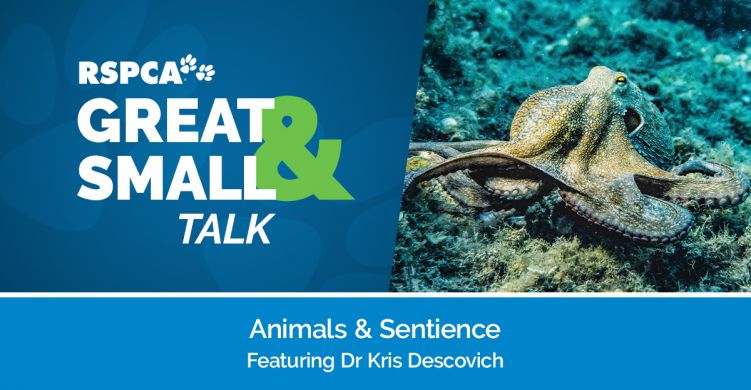
Brian: Hello, and welcome to RSPCA Australia's Great and Small Talk, where we discuss the pressing welfare issues animals face in Australia. I'm Brian Daly, and today we're discussing an area of research that has far-reaching implications for how we view, treat, and care for animals, and that's the area of animal sentience. And joining us to discuss this important topic is Dr Kris Descovich, Senior Scientific Officer at RSPCA Australia and adjunct research fellow at the University of Queensland. Kris, welcome back to the podcast.
Kris: Thank you. I'm so happy to be here.
Brian: Now, animal sentience is a topic that has been growing in prominence over the past couple of decades, not only in research and animal welfare circles, but it's also finding its way into legislation, with over 30 countries around the world now formally recognising animals as sentient beings. So, firstly, Kris, can you give us an overview of exactly what sentience is, and why it is important for animal welfare?
Kris: Yeah, absolutely. So, when we say that a species is sentient, essentially that means that it's capable of having conscious subjective experiences, and what that means is, as it's going around through its life, there are things that are happening to it, and those experiences are meaningful because they're experienced and interpreted and felt by the animal as being negative or positive, and when I talk about negative, I mean things that are unpleasant, things that might be described as painful or scary or distressing, and when I talk about positive, I mean things that are pleasant that might bring emotions like excitement or contentment or comfort. It's really important to realise that sentient is not specific to one particular type of experience like pain, and you can be sentient and experience a range of things, but not specifically pain. However, pain is very commonly used as a benchmark for sentience and research, so it is discussed a lot in this kind of discussion, but sentience is not specific to that, and actually we know from people that there are a small number of people who actually lack the ability to experience pain. Of course, they're sentient, they still experience a wide range of other things, but they just can't specifically feel pain. The reason why sentience is so important for animal welfare is because animal welfare is not just about the physical health and well-being of an animal, it's also about their emotional and psychological health as well, and when an animal is experiencing a lot of negative or very intensely negative things, it will be suffering, and on the flip side of that, animals can experience positive things, that means there are things in their life that they're important to them to experience, and that having those experiences helps to provide them with a life worth living. So that's why it's really important for us to understand if an animal is sentient, because it allows us to recognise that they have both emotional and physical needs.
Brian: And what's the relationship between sentience and emotions?
Kris: Well, emotions are a type of experience that has positive and negative qualities. They're not actually always conscious. We do experience emotions unconsciously as well, and the conscious component is what we would consider to be our feelings, and these aren't the only types of experiences we can also consider things like moods, and moods tend to be like longer lasting and more persistent, and then we also have other sensations, which are more our experience of the things that are happening to our body, and they're things like pain, which are emotion-like, but aren't usually specifically defined as an emotion, and the reason why these are very likely to occur in animals is simply because they're incredibly important for survival, and they're important for thriving as well.
So, experiences like feelings, they help animals to learn about the world around them and adapt to the things that are happening. They help them to predict what's going to happen next, and that allows them to make decisions that are going to keep them safe, and it's going to keep them healthy, and when I talk about things like specific emotions and feelings, like pain, for example, I really think it helps to consider these as not being specific feelings, but rather categories of feelings, so if we think about pain, for example, we don't just feel one type of pain, so we can have aching pain and burning pain and stabbing pain, and it's the same with other experiences as well, like fear. So, the fear I experience in one context is very different from the fear I would experience in another scary context, and the same is true for positive experiences as well.
And, like I mentioned before, like some of these experiences are very strongly and very directly linked to survival. So, pain, for example, clearly tells us that our body is in danger, and that we need to act in a certain way to get our body out of danger, or to help recover from something that's already happened. And fear is similar, it tells us there's something dangerous in our environment, and we need to act in a way to remove ourselves from that thing that puts us in danger. And these ones that are very directly linked to survival, they're likely to be widespread because of this direct link. So we're very likely to see those kinds of experiences in different animals across the animal groups, and it may be that there are some other kind of emotional or feelings that only specific animal groups will experience, so if we take an experience like jealousy, for example, which we know humans are capable of feeling, it's possible that some animals actually do feel a feeling like jealousy, particularly if they're a social species, because you can imagine that jealousy might act in a way that helps them protect those social bonds, but of course not all species are social, so for a species actually asocial, it doesn't spend time with its other animals of its kind, then it's probably not very meaningful for it to experience an emotion like jealousy. So we do need to consider what are the likely states and experiences an animal will have based on their behavioural biology and how they've evolved.
Brian: So it sounds like sentience is fairly widely recognised across groups, but how do we know if an animal is sentient?
Kris: It's quite tricky, isn't it? Because, unfortunately, we can't ask them verbally, we can ask people, of course, and that makes it very handy, and there's no single indicator for sentience in animals. There's no litmus test, which would also be very handy. There's not also complete consensus on which are the most important indicators. There is a really useful framework that came out a couple of years ago, and it was developed by Birch and colleagues in London, and it's a framework that relies on eight specific indicators. It's important to know that this framework was specifically designed to allow those researchers to make assessments about whether specific species feel pain, and so the indicators that have they've chosen are ones that have centred pain as the experience of interest, and so you do have to choose indicators that are based around the specific experience you're looking to interpret on. So, although this framework is focused on pain, again, just a reminder, sentience isn't specific to pain, but I still think this is a useful framework to discuss as an example. This framework does come at this approach by again saying there's no single indicator that we can say 100% with confidence, but their philosophy is that the more indicators a species ticks those boxes off, the more confident we can be that that species and the taxonomic group it comes from are in fact sentient.
Now, these indicators, they do tend to separate into two different types of indicators. The first is around the physical aspect, so they're things like the anatomy of the animal, the physiology, and the neurological indicators, things like neurotransmitters, and the second group of indicators are around the psychological indicators, and generally, because they're internal and can't be assessed directly, they're usually measured through looking at the behaviour of the animal. So, if we think about first those anatomical indicators, and again, remembering this is focused on pain, we have to think about what is the kind of physical aspects that would be required for an animal to feel pain. Now, this isn't so straightforward, because actually, what we think of pain is often sometimes nociception. There's two components to pain-related behaviour, and not all of that is conscious. So, to give an example, if I go into the kitchen, I put my hand on a hot stove, my body will react so quickly, it will pull my hand off that stove faster than I can think. That's actually a reflex behaviour. It's genetically encoded. It doesn't require any conscious thought, and because it doesn't require conscious thought, it's also not evidence of sentience, and that's called nociception.
Pain, on the other hand, is the conscious experience that happens after that, so that's me becoming aware of that tissue damage, feeling what that tissue damage feels like, me making decisions about how I'm going to treat that wound, and importantly, how I'm not going to do the same silly thing in the future. So that's really that conscious experience of pain, and that's the difference between the two. So when we think about the anatomical structures required for that pain, rather than just nociception. We have three main components. The first is that the periphery of our body allows us to detect those signals that are dangerous. Then we have the components of our brain, which allow for that pain and complex processing, and the third thing is the connection between those two components, so that brain processing part is called the integrative brain region, but it's not actually a specific part of the brain, it's just the term used for that part of the brain that allows for that complex processing, and so different species will actually have different parts of the brain that allow that, so in humans it's the neocortex, and that's the same for all mammals and other species don't have a neocortex, but they will still, they may still have brain regions that act and to have the same function, and we know that's true for things like birds and fish, and also like decapod crustaceans and things like that. Now, of course, as a species, it's a bit more further and further away from what a human brain looks like ... it does become more difficult to recognise which brain regions might be relevant, but really it's really important just to understand about which brain regions have that function rather than when they, whether they look similar to the human brain region.
So I guess the other part of that is really the psychological part, which to me is always the most interesting part, because it's really about how animals take on those signals and how they behave, and how we can be confident then that they're not just acting reflexively and instinctively, but they're actually having these complex processing, which are guided by feelings, and so trying to get away from simple behaviours that are purely reflexive. One of the things that we want to look for is really, is the behaviour relevant to the situation? Are they acting appropriately in the situation, and if the situation changes, does their behaviour also reflect those changes? Is the behaviour quite simple, or is it quite complex? Are they taking experiences they have now and applying learned behaviours in the future, and are they also able to make judgments around situations that actually trade off things that we would expect them to like against things that they don't like, and are those decisions that they're trading off changing based on what we would consider to be their internal state, like their feelings around the things that are happening. So that's quite complex, and I wondered if it might be helpful to give a couple of examples of what I mean.
Brian: Sure, sure, that'd be great.
Kris: So, let's take myself, for example. I could consider myself a sentient person, but let's say I have a painful experience, and I accidentally catch my arm in the car door. Now, that's a painful experience for anyone who's done it, or a finger, but that pain experience isn't stable. It changes over time. So, that experience I have, like at that point in time, is very different to how it feels a few seconds later, a few minutes later, a few hours, and maybe the next day, depending on how severe the situation is. So, of course, what I would do first is I would check the wound, I would look over the wound, I would maybe guard my arm, hold it against my body, I would maybe support it with one of my other arms, and then, as long as I haven't done too much damage over time, those behaviours would dissipate, and I would slowly get back to normal, unless someone accidentally knocks my arm the next day, and the behaviours and the pain returns ...
Brian: ... starts again ...
Kris: Exactly, so this actually identical behaviour has actually been shown for octopuses, where they've experimentally injured an arm, and those octopuses have actually shown those exact behaviours that I mentioned. They have an initial reaction, they check the wound, they guard the arm against the body, they cradle it, and then over time those behaviours change along with what we would expect their pain state to be changing with once those behaviours have dissipated, if someone accidentally touches the arm or gently touches the arm, those behaviours reoccur. So this is really interesting, because it really shows that these behaviours that they're showing they're very aligned to a potential pain state, and they're very flexible to the situation. So that's one study that's really interesting.
And the second study I wanted to mention was one that was done in fish, and this is really around those advanced decision-making properties that animals can have. And what they did is they experimentally tested zebra fish, which are very commonly used in research settings. And what they did is they asked fish to choose between different habitats, different tanks. One had lots of things that they tend to be attracted to, like plants and fish in another tank, and the other one was pretty much bare, like barren, and of course they fish gravitate towards the furnished tank with the things that they tend to like, but then they exposed some of the fish to a procedure that was anticipated to be painful, it was like a skin irritant injected into them, and the control fish had an injection, but it was just salty water, and then they looked at their habitat preferences, as long as the two tanks remained the same, the preferences were the same. However, when the barren tank had pain relief added, the fish with the skin irritant actually spent half their time in the barren tank, where they could access pain relief.
Now this is really interesting, because firstly, it shows that they have decision-making properties where they're balancing things that they like in two different contexts, but each tank had something that they wanted and something that they didn't want, and they had to decide based on that, but it only ever affected the experimental fish, because the control fish didn't have any pain states, so they just remained in the furnished tanks, and they didn't change their preference, so it's definitely good evidence that the fish were feeling a pain state, and that the pain relief was effective in relieving that state, and they were making reasonably complex decisions about where they wanted to spend their time based on their internal needs at that point. So, this is pretty good evidence for sentience in fish as well.
Brian: Yeah, so you mentioned a few species there, fish and octopus and mammals, which species or animal groups are considered to be sentient? And also, are there any animals that are not considered to be sentient?
Kris: Yeah, there is good general scientific consensus that vertebrates are sentient. So, there are things like mammals, birds, reptiles, and fish. There's strong confidence for cephalopods, so cephalopods are things like octopus, squid, cuttlefish, and nautiloids. There's quite a bit of research done on them, and reasonably strong evidence that they're sentient. There's pretty strong confidence for decapod crustaceans, so they're things like crabs and lobsters. There's actually quite a bit of evidence for which may be surprising for sentience in some insects, at least at some particular life stages, so there's a bit of research done in bees, some done in flies and cockroaches. I do think it's pertinent to point out that the UK's Royal Entomological Society now has an ethical statement about using insects in research that calls for harm minimisation based on the fact that there is some emerging evidence, and that researchers should now start to take into consideration if they can minimise impacts on insects if using them in research. I do think this is probably the space to watch, in terms of obviously it's a massively diverse group of animals, but they are widely used in research and also farming. So, I do think this will be a space that some interesting research will come from in the future, in terms of if there are any that are not considered sentient, I will say I couldn't find any evidence for against sentience in any species.
What I did find, though, was a lot of lack of information in a lot of different species. So, there's a real bias in terms of which species are being researched for these capacities, and there is a whole range of animals that really haven't been looked at at all. So, these are things like, for example, mussels and jellyfish, and things like that. There's actually a small bit of evidence for sentience in some bivalves, like scallops, that do suggest potential sentience, but there is really a lack of research, and I think really important to point out here that a lack of evidence does not mean a lack of sentience, it just means a lack of research.
Brian: ... and evidence ...
Kris: Absolutely, and that evidence is important, but choices around what research is made and which species to research is a human-generated decision. It's not based on necessarily the sentience of those animals, but typically tends to be which access, which animals are accessible, and which are used in other purposes.
Brian: So that's a wide range of animal groups that are considered to be sentient. Currently, the ACT is the only jurisdiction in Australia that recognises animal sentience. So, how important is it that sentience is formally recognised, for example, in legislation or policy?
Kris: Yeah, absolutely. It's really important. It's really important that it's explicitly really recognised in legislation and in policy, but also other documentation that really sets out the expectations for how we treat animals. For example, it could be added into codes of conduct or codes of practice. What this means is that we have, if we have sentience recognised in legislation, it means we recognise that animals have the capacity to suffer. We recognise they have the capability for pleasurable experiences as well, and it sets out expectations for the protections of those animals and for providing for those animals in ways that are meaningful for them.
So, for example, it might mean that we recognise that animals don't just require physical help and physical welfare, that we need to also recognise they have these emotional and psychological needs. Importantly, they can be injured psychologically and emotionally if they're not treated properly, and therefore we also have a responsibility for them that sets out basically not just how we provide them physically, but how we provide for them emotionally and psychologically in a way that's meaningful for that species and that individual, and it also helps provide transparency around decision-making processes in terms of how animals are treated in different legislation, and where perhaps there might be some differences in species and how they're treated, despite both species being sentient, so it does provide transparency and some equalness level in terms of how we make decisions around how animals are treated.
Brian: So, you mentioned before about evidence and how a lack of evidence doesn't necessarily equate to a lack of sentience. So, what is the precautionary principle, and how is it applied in practice?
Kris: Yeah, essentially the precautionary principle in this context is where there's potential for serious and negative animal welfare outcomes. A lack of complete scientific certainty as to whether those animals are sentient is not a sufficient reason to postpone cost-effective measures to prevent those outcomes. Essentially, what this means in practice is that we can't place unrealistically high burdens on evidence as a way to negate our responsibilities towards animals, if there's reasonable evidence that that species group is sentient, because we know that animals suffer both from having negative things happen to them and also when they're deprived of things that are very important for them, and if the things that are done to them in when we're using animals in industry. If those things are very damaging, they're very painful, or very frightening, or very depriving, then we need to take action to try and prevent those outcomes.
So, I think there's a couple of things to think about here. Firstly, it's really important to think about the fact that there are these species groups where there's not a lot of research done on them, that doesn't mean they're not sentient, it just means we don't yet have evidence for sentience. Similarly, it means that when there's sufficient evidence in one particular species, we can use that as evidence across the taxonomic group within reason, as long as the other species are sufficiently similar, because it's completely unrealistic to expect sentience research to be done at every species. If we just take, for example, crabs, which are quite a big focus at the moment in terms of sentience research. If we take the true crabs, which is only one group of them, there are more than 6,000 individual species. So you can see how it's a completely unrealistic burden to see send evidence of sentience in a few of those species, and then to say we can't cross that interpretation across to those other species.
Brian: It's amazing the research that's going on on such a wide range of animal groups. I mean, I think anybody with a with pets knows that they have emotions and they have feelings, but these developments in the wider area of animals and groups is great to see that development there. What developments do you hope or expect to see in the future in regard to animal sentience?
Kris: Yes, absolutely. I mean, I do think anyone who owns a pet and watches their pet day in and day out, they pick up very subtle changes in their pet's behaviour, and those changes are very strongly linked to the experiences of those animals. Anyone who's had a dog who's been afraid of thunderstorms, knows immediately when a thunderstorm is coming, because the dogs ... the quality of their behaviour changes so significantly, and it would be such a stretch for anyone to look at a dog behaving in that way and not draw the connections that they are having a very strong, effective experience, that they're having very strong emotions, and we know also when they have those experiences, they're very long lasting and persistent and very detrimental to the welfare of those animals.
What I do hope in the future is firstly that the concept of sentience is meaningfully recognised in legislation, particularly the Prevention of Cruelty Acts in each state, and I also hope that some of the research we don't have a lot of research on gains some attention in terms of their capabilities. The other thing I really, really hope is that sentience, in terms of its research, starts to move away from a big focus on the negative experiences of animals, because, like I said before, sentience is not reliant on an animal being able to feel pain or fear. If we can prove sentience in terms of their positive experiences, that's also evidence for sentience, and we, we've now moved away from a concept of animal welfare, where we consider just trying to remove negative experiences is enough. We know we need to provide positive experiences for animals, so that they can have a meaningful life. And I really hope sentience research also has its shift, so that we gain more information into not just whether they are sentient, but what things are meaningful for them, and what things will help us to provide with them a life worth living.
Brian: Yeah, couldn't agree more. It's a, it's a really fascinating area to discuss with you, Kris, and I really appreciate your time joining us today. You know, it's fundamentally changing our understanding of the animals and the care and respect we provide, and we give these other sentient beings that you know we share this planet with, who are able to feel those emotions, feel the positive as well as the negative, as you say, to give them a meaningful life, just like we need those parameters to live within for a meaningful life. So, thanks again for joining us. It's been great talking with you today.
Kris: Thank you. It's my pleasure to be here.
Brian: We've been talking today with Dr Kris Descovich, Senior Scientific Officer at RSPCA Australia. And thank you for listening. If you would like any more information on animal sentience, you can visit RSPCA Australia's website at rspca.org.au or the RSPCA Knowledgebase at kb.rspca.org.au. You can also subscribe to the podcast series at the RSPCA website, or any of your favourite podcasting platforms. I'm Brian Daly, and I look forward to your company next time on RSPCA Australia's Great and Small Talk.