Transcript
Peter: I love the fact that when you get an animal from the pound, you can really see their personality and see whether it suits you, because every time somebody says to me, "Oh, I want to get a dog. I want to get this dog." I always go, "Don't go by the breed. Go by what personality is going to suit your lifestyle."
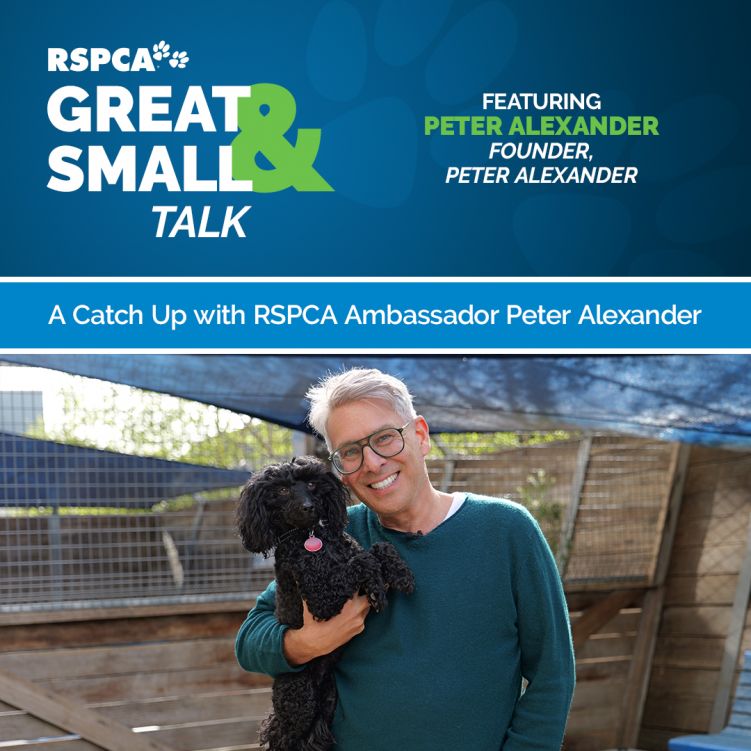
Brian: Hello, and welcome to RSPCA Australia's Great and Small Talk, where we discuss the pressing welfare issues animals face in Australia. I'm Brian Daly, and today my guest is one of Australia's most successful fashion designers, entrepreneur, founder of the iconic sleepwear brand that bears his household name, and generous and long-standing supporter and advocate for animal welfare, raising millions for animals through his business, his philanthropy, and as an ambassador for RSPCA Australia. Peter Alexander, welcome to the podcast.
Peter: Thank you for having me.
Brian: Peter, can we start with talking about your beloved little sausage dog, Penny? You've said previously that she became both your mascot and your motivation for giving back. Can you tell us a bit about her origin story and and how your special bond came about?
Peter: Yeah, look, I've always been a crazy animal lover from when I was a kid. I never wanted toy toy trucks or footballs. All I ever wanted was like little toy animals or colouring books that had animals in it. I was always born with this crazy animal feeling. My mum had three kids and didn't really particularly want any pets on with that, which now I understand. So I never really had ... we had a few few dogs growing up, but not ... only when I was really young. When I started my business, about like four or five years after I started my business, I was walking down the street. I was on a lunch break, and I walked past a pet shop. They used to have pet shops in those days, and I saw some sausage dogs in the window, and they were on sale, and I looked at it and I thought, "How can you put a living, breathing, lovable thing on sale? It seemed a bit weird to me, so I just went into the shop and I said, "How come those dogs are on sale? And she said, "Oh, because they're already four months old, and people tend to want really young puppies that are only 10 weeks and stuff, so we find them harder to clear. And I said, I said, what happens to them if no one buys them? And she just looked looked at me and said, I actually don't know. I think we just send them back to the breeder. And I thought that was such a weird sort of ... it's sort of just something in me thought that was so weird. And so a spur of the moment, I don't know why. I just literally picked up this little dog, little female sausage dog, and held. And I thought, I think I was going to take this with me. And I went back to the office and I said, "Guess what I got? Got for lunch a hot dog. And I hadn't planned to get a dog. I didn't want to get a dog. It just happened. So then I was my first adult dog as an adult, and I fell obsessed with the dog and named it Penelope Jane after PJs. So it was Penelope Jane. It got abbreviated to Penny, of course, and I became literally obsessed with her, and she ended up changing my life.
Brian: And your brand? Did she? Do you think she unintentionally shaped not just your brand but your values as as well?
Peter: I think. Look, she she totally changed me as a person. Because I became so obsessed with her. This was in I think early 90s, and there was a brand called Abercrombie and Finch that used to have little mooses as their logo. And I thought, oh, I should use Penny as my logo. So because I was so obsessed with her, I thought I'll use my little sausage dog as my logo, and that's how the idea came. So I started using Penny as my logo, and also what happened with Penny in back in the 90s, people weren't very comfortable with mail order products, and I was a big mail order company, and they didn't they felt unsecure giving credit card numbers and things over the phone back in those days. So what I did was I did a lot of publicity and a lot of promo shots with me holding Penny, and people always trust somebody with a cute dog. So she became almost like, "See, I'm a nice person. I've got a dog." So she, I, I sort of used that that way to say, you know I'm just a guy who loves dogs who's selling pyjamas. Yes, you can feel free to send me money for the pyjamas. So she became sort of a bit of a trust icon for for me and a brand icon for me, and that was when I started feeling well, she's doing so much for me, I should pay back the animal kingdom somehow, and because I wasn't paying her for appearing in my catalogues, appearing in me in my PR, appearing on all my products, I figured I had to do the right thing and raise some awareness and money for the charities.
Brian: And is that how your partnership with RSPCA came about?
Peter: Yes. Well, again, when I started thinking about how to pay Penny back, RSPCA they had a great advertising campaign on television at that time called All Creatures Great and Small, and it was for those who remember, was a really cute little wombat running across the screen, and it just always tugged at my heart. So I thought, okay, well, I'm going to start donating money and giving back to the RSPCA instead of obviously paying my dog. So that's how how it started, and I used to just donate money, but then it started doing things where it was, well, how can the business help with that? So I had a few look in those days, I was in in my late 20s, and my two favourite things were hot boys and cute dogs. So I thought I'll combine the two, and I did calendars. So I photographed calendars of really hot boys holding dogs, and I used to sell them, and all the money went to the RSPCA because I always thought if I do something for RSPCA, I want 100% of the money that I raise to go there, not just oh 10% goes there. So I started raising money like that, and that was the first ... first way I sort of started giving I suppose bigger donations to the RSPCA, and then after that, it initially found out me talking to them and asking them how I could help more. So that's how it all started.
Brian: And you've, as you say, you've had some fun ways of (yes) of helping the animals. Is there any any anything along the way that you you're especially proud of, or that had a big impact on audiences.
Peter: Look, you know, obviously, as as I've got older, I've got less interested in in hot guys, and I'm much more interested in chocolate ... chocolates now. So now I do ... I ... priorities change. I ... I sell chocolates for humans, but all 100% of the money goes to the RSPCA. So we do all sorts of fun packagings with dogs on them and stuff. And and as far as being proud of myself, I'm not really proud of myself. I ... I think it's almost a bit of a responsibility when you're making money. To I know I pay tax taxes and stuff, but you know I just sort of think it makes makes me sleep better when I know I've done something that's good for my soul and from from from the heart.
Brian: Yes, and you you know all about sleep as well.
Peter: So yes, exactly, exactly. And yeah, people often there was sort of there was sort of a trend. Oh God, probably 15 years ago, 20 years ago, where every brand suddenly had to have a have a charity. You know, I we support breast cancer. We do white shirt day. We do this that, and it almost it almost became a little bit inauthentic. The brands were were thinking, how do we spin this marketing wise? I think the reason why I've stuck with the RSPCA for you know I've been working for almost 40 years now, but as an ambassador for 30 years, is because it was real, it was legitimate. It wasn't really about my brand; it was about me. I've my love for animals, and then I sort of worked that in into the brand, and then I gave back. So, I think consumers can, and the public can sort of sniff a marketing campaign out now. Everyone's a little more savvy, so I always discuss with other brands. You know, think about yes, what suits your brand, but also think us about you as a person and what really, you know, if if it's dementia that you're supporting, then you know you you would assume have a story about how dementia's touched your your life, or if it's you know, if it's about children's hospitals, yes, it's a great cause. But is there a personal story to to that, and is is it legitimate? Because if it's legitimate, it will last the distance of time, and people will understand the reason why. So that's probably the the reason for the longevity with my ongoing support for the RSPCA, it started off personal and still is personal.
Brian: And as you said, you you've always had this affiliation with animals, so it's it's it's obviously a very personal thing. What what is it about animals? Do you think that that drives you or connects with you so deeply?
Peter: It's the ... it's the trueness, it's the ...it's the rawness and the trueness of emotion that a dog, well, with me particularly dogs, with dogs show you there's no layers of ulterior motives, dogs live in the moment. They're happy when they're happy. They love you. There's something about their their energy and the response to you that's so true. And if if you take the time to absorb that and enjoy it and understand, you know, walking through the park gives them such enjoyment. It should give you that enjoyment rubs off on you. So I suppose I've I've always had the ability to soak in the energy and try learn from dogs that live in the moment, don't panic about tomorrow, enjoy today. Their love is so pure and innocent, and it's. I suppose it's like a child. I've never had children, but I assume it's a bit like a child. You know, when it when when your child smiles at you, there's nothing. I assume that is like like that. I'm not saying animals are like children in a sense, but to me, my personal view-that's the closest I've got to having a child.
Brian: As you say, they're just genuine in the moment, and there's no pretence.
Peter: No, there's no ... there's such happiness. They they can go happy so quickly, and I think we can learn from that. And they, yeah, they really live in the moment, and it does doesn't matter. They can be joyous in a little rental flat, or they and they're just just as joyous in a great big mansion. It's not about that. It's it's more about the time you give them. That's what makes them wag their tails.
Brian: And you've also adopted dogs from the RSPCA and other animal shelters, including your Ginger and Fred and Lucy at the moment are all rescues. Was that a conscious choice to commit to rescue animals after Penny?
Peter: Yes, it definitely was. It's funny ... the the dog. I've had dogs both from breeders and I've had dogs from shelters. The dogs from shelters have been a lot more easy. I look. Everyone loves a puppy, but they're they're hard work, and you've got to be able to give them that time. And I don't know. I every puppy's gorgeous. I love the fact that when you get an animal from the pound, They're normally, normally, you know, six months or above. You can really see their personality and see whether it suits you, because every time somebody says to me, "Oh, I want to get a dog. I want to get this dog," I always go, "Don't go by the breed. Go by what personality is going to suit your lifestyle." It doesn't matter what they look like. You're going to get so much more enjoyment out of them if they suit your lifestyle. So stop thinking about I want a schnoodle, I want a schnauzer, I want a dalmatian. It's it's that sort of irrelevant. It's a bit like a long term marriage, I suppose. You might be attracted to somebody's looks, but at the end of the day, you've got to be best ... best friends. So when you adopt a dog, you can tell a lot more about a dog that's older about what sort of personality it's got and whether it's going to connect with your your lifestyle. For example, I would never have thought I was a poodle person at all. I just never they never appealed to me. I thought I'm never going to have a poodle. It's an old lady lady dog and blah blah blah. Then I went to the RSPCA one day, and the the people there told me, "Oh, we got this really beautiful poodle in. I was like, "Oh, not really into poodles." And they said, "Oh, I just want want you to meet her." And so they brought her in, and she just literally ran, jumped on my lap, and and snuggled me. And I was like, "Oh my god!" And so I adopt adopted her, and I'm crazy about her now. You know, she's just-I love poodles now. So again, it's-it's to me, it's much more about the the energy and the personality of a dog rather than the look at the end of the day.
Brian: Have there been moments over you know the 20 years you've been working in this area that have affected you more deeply than you expected.
Peter: Look, I can't, I can't deal with any news story or pictures of abused animals. It just affects my whole day. So, you know, if I'm scrolling on a phone and I see something, I have to quickly scroll past. If the news is on, I have to mute it or change a channel. And I've also told the RSPCA, please don't send me any information with pictures because it just can emotionally make me not in a great place, and it sits with me for so so long. I'm surprised that hasn't changed as I've got older, and as I've worked the RSPCA, just I um I still get a really ... sadness about humanity when I see that. Um, so that's probably surprised me that I haven't been able to grow out of that, because it sort of seems like a, I should have been able to do do that. But you know, I suppose you just I get sad for the animal, but then I get sad for humanity. So I suppose that affects me.
Brian: I guess that demonstrates your depth of empathy for these creatures, so including human animals.
Peter: Yes, yeah, yeah. I just it yeah surprises me sometimes.
Brian: Yeah, it's it's it's difficult to look at those things and and not be affected. Yeah, no matter how many times you see it. Yeah, you've built a hugely successful business, but when you think about your legacy, does the charitable side of your life now feel just as important?
Peter: Look, the brand that I've built, I'm really proud of, and it's lasted for 40 years in business. And from a kid who had a learning disability and never passed school, and never went to university, and never studied, and I didn't know what I was going to be and what I was going to do. I'm very proud of that achievement. The RSPCA side and the charity side, I feel. Don't know if I'm proud of myself. I think it's it's a very nice perk for me of being financially stable to be able to do do that. I don't understand people who are in position choose not to, but I can only speak for myself. It seems like a duty rather than something to be proud of. I just see it as as yeah, it's like I don't know, growing old in taxes, finding a charity that affects you, and I know just it's just it's a private proud, it's not a public proud. I don't like a round of applause. Like I don't go to many events that the RSPCA hold that celebrate donation, people who donate. I don't want my name on a building. I'm not that sort of person when it comes to that. I think the reason why I'm not ... because I've got that already in my business side of life. So I don't judge anyone who likes all that because they probably don't have that in their business side of life. While I do have that, so I don't need that from the charity side of things. The charity side of things is definitely much more personal thing for me to acknowledge myself.
Brian: And you never worried about mixing business with advocacy?
Peter: No, it felt it felt right. It felt ... it, it felt correct. So that didn't concern me. I understand some causes might affect some businesses, and I understand people trying to keep them separate. But for me, it worked. My brand is about feeling good and happiness, and you know, I suppose spending quality time with yourself, and and the whole animal thing fits in with that at home. So it sort of it sort of gelled nicely.
Brian: And, and it really does. It comes through the the joy in your brand is is something that you do feel from the from animals as well, so it all marries up beautifully. Yeah, and is that the message you would give to younger business owners about long term philanthropy versus one off gestures?
Peter: Yeah, I think I can only speak for again myself, but I assume everyone's got a cause, whether it's you know global warming, whether it's ... I don't know whatever whatever it is. I think if if you haven't got a cause that rocks you emotionally, I don't know. It's hard to speak for other people, but all I can say is, if you decide that your business wants to support a charity, make it make it authentic either to your customers or to you. If you you you're not passionate about anything, are your customers like ... Witchery used to do a great ... they were one of the first brands to do a great breast cancer collection, and I their their women were targeted to that particular age that that worked on. So even though it might not have been something that the boss had a connection to, his clients had had a connection to. So it was it it worked. So yeah, I think rather than just picking the flavour of the month charity, give it a bit bit of thought about whether what if it's not personal to you, is it personal to your customers?
Brian: Yeah, that's great advice. Peter, is there anything else you wanted to cover off today?
Peter: No, just just enjoy your animals. Remember, any time spent with them is is is a present to them, and yeah, just cherish their energy and their happiness, and try soak it in, and yeah, buy some pyjamas
Brian: Because they they help them. They do everything. They help everything. Well, well, thank you very much, Peter, for talking to us today. It's been absolute pleasure, and thank you for your incredible long-term support and advocacy for all creatures great and small. The impact you've made on the lives of of countless animals over these past couple of decades ... just phenomenal, and may continue well into the future. And yes, please keep making me my pyjamas as well, I really appreciate that. So, thanks again for joining us.
Peter: Pleasure, sweet dreams, everyone. Bye bye.
Brian: We've been talking today with fashion designer, philanthropist, and RSPCA ambassador Peter Alexander, and thank you for listening. If you would like to find out more about Peter and Penny, and support his long-term advocacy for animal welfare, you can visit the About Peter page on the Peter Alexander website, and remember, you can also subscribe to the podcast series at the RSPCA website, rspca.org.au, or any of your favourite podcasting platforms. I'm Brian Daly, and I look forward to your company next time on RSPCA Australia's Great and Small Talk.