Transcript
RSPCA: Protect your pet with RSPCA Pet Insurance. Informed by over 150 years of animal welfare expertise, it's cover you can trust, and your policy helps support the RSPCA's work too. Visit rspcapetinsurance.org.au for a quote. RSPCA Pet Insurance. We know animals. Policies issued by Pacific International Insurance (AFSL) 523921, and distributed by RSPCA Pet Insurance AR 1318294. Visit our website for more information.
Melissa: I think it really comes down to having a chat to your vet and finding what are the likely things that we can foresee that we'll need to cover, and therefore, is your insurance that you're looking at likely to cover those?
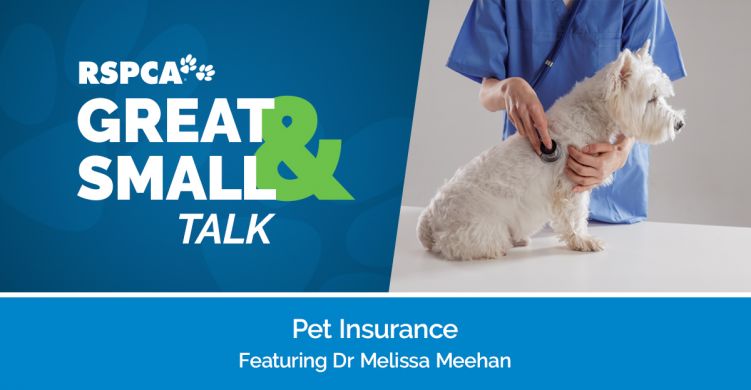
Brian: Hello, and welcome to RSPCA Australia's Great and Small Talk, where we discuss the pressing welfare issues animals face in Australia. I'm Brian Daly, and today our topic is one of great relevance to the owners of the estimated 28 million pets in Australia, and that's the subject of pet insurance. And to give us the lowdown on pet insurance and how it can be of benefit to both pets and their owners, I'm joined by Dr Melissa Mehan, Director of Veterinary Services at RSPCA Victoria. Welcome to the podcast, Melissa.
Melissa: Thanks, Brian. Looking forward to chatting about it.
Brian: Everybody that owns a pet knows how wonderful they can be, but they can also be expensive beyond regular checkups and vaccinations. Unexpected issues can and do arise that sometimes require quite significant veterinary care and equally significant costs that go with that, and that's why many insurers offer pet insurance to help. So, Melissa, can you tell us how pet insurance actually works in Australia and how it is different from human health insurance, say like Medicare?
Melissa: Yeah, obviously within our country, there's a universal health scheme, which is supplemented by the government. With regards to pet insurance, it's very different. It's reimbursement based, policy based, and very individualised.
Brian: And what kind of pets and treatment are typically covered? And also importantly, what's almost never covered?
Melissa: Yeah, good question. Got to check that fine print. The most common species to be covered are, of course, dogs and cats. There's some insurers that do cover horses and some of the more pocket pets, but dogs and cats by far. In terms of things that are not covered, it does vary from insurer to insurer, and you really need to check this out. Do your due diligence before you head into one of them. There's often exclusions which are around dental disease and routine care, so vaccinations, worming, and so forth. It depends on your add-ons.
Brian: Yeah, true. Yeah like (yeah) like we do with our own health insurance.
Melissa: Yeah, yeah, but it's so variable from one insurer to the other. Often with behavior that's not covered, so you've got to look at your pet and tailor the insurance to the individual.
Brian: Because pet insurance wouldn't cover everything that a veterinarian recommends.
Melissa: No, first of all, things need to be included within your policy as per what you've signed. So you may have elected to exclude certain add-ons, or you might have chosen to pay a higher premium to add them in. The core thing that insurance covers is emergency and accidents. So, if an emergency like a tick paralysis or a car accident, being hit by a car, things like that, that are catastrophic or unexpected and occur without any notice, they will also cover usually diseases like skin disease, ear disease, diarrhea, things that you might see the pet for on an everyday basis. But as I was saying before, you need to check for those other things. Do they cover specialist care, and what are the sub limits? So, if your animal, for example, ended up having to have extensive care for something like, say, snake paralysis or orthopedic care that occurred due to a trauma, and there was a lot of support that was required in 24 hour care, and you were going to blow out that bill to the 10s of 1000s of dollars. You need to check whether your insurer will actually cover that, and where they stop.
Brian: Because there would be limits. And and you mentioned premiums again. What factors influence those premiums? Is it to do with breed or age or location or something?
Melissa: Yes, yep. So I suppose the first thing is to insurers look at risk, and if the risk is high to insure your pet, then you'll pay higher premiums. So certain breeds, like your brachycephalics, your pushed-in face dogs, we love them and they are gorgeous, but they're a little bit more high maintenance, so to speak, and so insurers see them as a higher risk. Older pets can also be higher risk. Pets that are in areas where vet bills are higher will ... will also be insured for a higher premium and at a higher risk of accident. So, say your dog does a lot of activities that are off lead, or they live in an area where there's a lot of exposure to paralysis tick or snakes or things that could occur as an accident. The other things that then they're going to affect premiums are the things that you can control. So if you look at your benefit percentage, so when you go in and say you've got $1,000 bill, how much of that is the insurer going to cover? So if your pet insurance has a benefit percentage range of 60 to 90% if you went in and you'd chosen the maximum benefit percentage, they'd be paying $900, as long as the policy said they'll cover that problem, and you'd be paying 10% of that. So you'd be paying the $100, but your premium goes up. Same with excess. So every time you have a claim, you've got to check. Do you need to pay it excess, or is it just a once-off? And that excess, you can change. You can make it higher or lower, but it's inversely proportional to the premium.
Brian: Yes, yes. So, as you say, it's all about the risk and what you can afford to take versus what if that happens, and I'll have to pay that bit of extra.
Melissa: Exactly. That's right.
Brian: And you mentioned that age is one of the factors. Is there a point in a pet's life when it is too late or or less worthwhile to get insurance?
Melissa: The cut off is around sort of the nine years of age mark for dogs, cats a little bit more. But as a pet ages, we know that that's when we start to go the vet a bit more for blood tests, check on their general health. That's when organs and things start to slow down. Heart disease might appear, and things just start to, like with us, fall apart a little bit.
Brian: I can relate.
Melissa: So could I, sadly. Yeah. So the question is, you know, is there a point where it's there's no point to insuring an animal, and I think it really comes down to that insurer and having a chat to your vet and finding what are the likely things that we can foresee that we'll need to cover, and therefore, is your insurance that you're looking at likely to cover those?
Brian: And when does pet insurance make like financial sense versus just say people putting money aside in an, in an emergency fund for if something comes up.
Melissa: I think it makes financial sense depending on the individual. So I always say to people: first thing to ask yourself is if your pet has a medical emergency or develops a cancer, are you in a position where you would morally want to treat that optimally and to the full, or would you not treat it? So that's the first question. And if you don't treat it, of course, you're still looking after welfare, but you're choosing a faster outcome. So if you're willing to treat it, then you need to think: Is there going to be stress associated with a catastrophic event or an unexpected event that could run into the 10s of 1000s of dollars. Is that going to create you financial stress at the time? And if it is, or if it's going to affect your ability to choose optimal care, which is stressful, then I think pet insurance makes sense because it takes out the it's a ... takes out the financial risk.
Brian: Yes, so you can just make those decisions based on the care needed.
Melissa: Exactly, without having to really, sort of, discuss different options with the vet, which is really stressful. And then, and while that's happening, your pet's welfare is compromised. Some people choose a hybrid approach, so they'll have an emergency fund, which covers that excess that they'll have to pay, and then they can reduce their annual premiums because they know I can at least cover X amount.
Brian: And Melissa, why are vet bills so expensive? And they seem to have grown a lot over the years.
Melissa: I think veterinary care follows very close behind human medical care, and that's advanced massively in the past decade. The things that we can offer now for cancer and orthopedics and so forth, and veterinary care is expected to follow suit. A lot of people want to pay those amounts, but if they even if they can't pay, they expect to be able to give that to their pet, the same care that they were afforded. So veterinary clinics have to have that infrastructure, that education, ready to go. And we know that optimal care therefore comes at a price. So that price is very difficult for a lot of people to cop without warning, and and that's really stressful for a vet because we're standing there on one hand saying we can save your pet. I want to save your pet, but this is how much it's going to cost, and I can't help that. It's it's not going to go my pocket. It's just how much all the equipment and so forth costs.
Brian: Yeah.
Melissa: So I think that's why it costs so much, and vet clinics are multimodal. They offer everything. They're doing the anesthetics, the pathology, you know, all of that stuff that would normally be outsourced in human care.
Brian: I think people forget that they're called veterinary hospitals, and they run the entire ... an entire hospital with, with all those same treatments for ... for all the species.
Melissa: Spot on. And the the difference between us in Australia, we ... we have Medicare. So when we go into the public health system and we have something treated, I've got no idea how much it costs. But in America, for example, they know exactly how much things cost. So there tends to be more appreciation or acceptance of vet fees because of that difference. We're losing so many vets in the profession, not because they're not financially backed, but because of the stress and the pressure that's put on them because of these fees. So it's not their choice.
Brian: And I guess this is ... insurance is a way that you can help people make those decisions based on the care rather than the cost.
Melissa: Until the government develops a scheme where they support veterinary medical care, which ... which I wish they would eventually, because animals are so important to our society. Yes, pet insurance is the only other thing that can act as a ... as a financial risk mitigator, and I think if everyone had pet insurance, then we'd be able to maintain these really bright minds in an industry where pet lovers would love to keep them.
Brian: It would go a long way to helping that situation.
Melissa: It would, it would.
RSPCA: Protect your pet with RSPCA Pet Insurance. Informed by over 150 years of animal welfare expertise, it's cover you can trust, and your policy helps support the RSPCA's work too. Visit rspcapetinsurance.org.au for a quote. RSPCA Pet Insurance. We know animals. Policies issued by Pacific International Insurance AFSL 523921 and distributed by RSPCA Pet Insurance AR-1318294. Visit our website for more information.
Brian: You know, everyone's talking about the cost of living and and rises and all those. It's like everything in life having to look at what I can live with and what I can balance and what we can afford, and also thinking about you know you've mentioned those risk factors that when it comes to their pet's health. You know that ... that's really a key thing, isn't it?
Melissa: It is, and I think we all and I'm guilty of this. You know, they coast along for the first seven years, and nothing really happens, and we sort of presume that nothing will because we hear those stories of the dog that lived till it was 15, and then it just passed away in its sleep. But that happens so few times. Most of the time, they take a lot of management and care in those latter years, and the time to take out insurance is when they're healthy, because that's when you're going to get the best premiums and the best offers from the insurance companies.
Brian: And are there certain breeds or lifestyles where in where insurance is almost I would say essential?
Melissa: Yeah, I'd go back to those cute little brachycephalic breeds. So your French bulldogs, your pugs, I'd take out insurance as soon as you can. Anything that does a lot of agility work that may be more inclined to have a sporting injury like a cruciate ligament rupture, and having said that, when you do look at the fine print of your policy, you want to make sure that waiting periods, which are also included as exclusions and other exclusions like pre-existing conditions, aren't a problem, and bilateral disease. So asking, well, if my dog does one crucial ligament, are you going to then call it a pre-existing problem and not cover the other one?
Brian: Ah, okay. (Yeah) So that's interesting. So, so how are these pre-existing conditions ... ? How broadly are they defined by insurance?
Melissa: It depends on the insurer, and it ... and it goes by anything that is in the vet record, so they'll look at the vet record, and if there's a mention of a disease that has led to the current disease that you're asking to be insured, then they may argue that it is a pre-existing condition. So, for an eye problem, for example, if your dog presented with a red mucky eye, and it was a bit of hay fever, and it was called conjunctivitis. Then, and then you were insured after that. It's likely that that would be considered a pre-existing problem, and any time that that represented, you wouldn't be covered.
Brian: Okay, so best to get in early then. It sounds like it.
Melissa: While they're fit and healthy and perfect.
Brian: Exactly, because you know, people, some owners would think oh my pet's healthy. I don't need insurance. You know.
Melissa: Yeah.
Brian: Why do, why do I need to do this now?
Melissa: But that's when you take it out. You've got to do it.
Brian: It's a bit flawed that logic.
Melissa: It is. It is. Yeah, but that's that's the logic. I mean, you wouldn't live in a house and not insure it. Most people have their house insured. They have their car insured, so we can go for our whole lives without having anything happen to either of those things. I think we have to apply even more of that logic to a biological being.
Brian: Yes, because things definitely do go wrong. And you know, you're talking about exclusions as well. Are there any common exclusions that might surprise policyholders?
Melissa: Yeah, one of the things that really surprises people is the waiting period. So it will depend on the insurer, and it will be depend on the age of the animal and the problem. But there will be a period where you can't make claims for certain things. So you really need to look at that, and that's why get in early. In terms of other exclusions, I find something that's a bit of a ... an annoyance from a veterinary point of view is dental disease. That's something that is so prevalent, and it really affects animal welfare. But it's often not covered unless you include it as an add-on.
Brian: Right. So that's another thing to look at in the policies. What are the add-on options that you can look at?
Melissa: Yeah, and how they're presented, Brian. Because some of the insurers will bundle them up with other things, so you might have no choice but to put dental care with other things that you would never use. So you want to look at insurance companies that allow you to really pick and choose and narrow down the add-ons that you pop on.
Brian: And how regulated is the pet insurance industry in Australia?
Melissa: It's regulated by APRA and ASIC, so they make sure that the insurance companies have got enough money to pay funds. But in terms of the regulation in the fine print, people have a right to ask for the product disclosure statement. So if you don't have access to that, you have every right to ask for it, because that's where the fine print is, and that's what I'd encourage people to really check.
Brian: And what would you tell a first-time pet owner who's unsure or overwhelmed by the options that are presented?
Melissa: I think the first thing to think is what are your non-negotiables? So go to your vet and have a vet care plan, a budget plan that you come up with. Talk to them about your breed, your lifestyle, and what they foresee are the likely things that might come up, and then write them down. Go away and have a look at the different insurers. Shortlist to about two or three that cover those things specifically. Make sure they're not in bundles that have got useless things to you, and then start to look at the fine print. Look at exclusions and make sure that your pet isn't overrepresented in those exclusions, and also pre-existing conditions that they may have had so really look at those, and then once you've sort of shortlisted to two or three, have a look at the excess that you would be willing to pay. So if something comes up, something that's expensive, how much money are you likely to not be stressed about having to part with? Imagine that, and then you can work out your benefit percentage. So what percentage the insurer pays, and that you're left to pay, and the excess that you're willing to pay, but make sure you don't have to pay excess every time, and that you're just having to pay it once because there is that difference between insurers.
Brian: And that's, I guess, how owners can balance their financial limits with the desire to do everything possible that they can for their animal.
Melissa: That's right. I think it's just about taking it out early and really just having a chat to your vet about what your pet's going to need, and that allows you to really narrow it down.
Brian: Yeah, great advice. Thank you so much for joining us today and sharing that with us, Melissa. It's, I mean, as you say, it's obviously something to consider when you're planning on adding a new furry member to the family, and it's very important, as you say, to do your research and look at what will best suit you and your pet's individual needs. I think that's the thing that's come through clearly to me when it comes to their care. So, thank you again for all your advice and all your help.
Melissa: Absolute pleasure, Brian.
Brian: We'll talk to you again soon.
Melissa: Thanks very much.
Brian: We've been talking today with Dr Melissa Mehan, Director of Veterinary Services at RSPCA Victoria, and thank you for listening. If you would like to find out more about pet insurance, you can visit RSPCA Australia's website at rspca.org.au. You can also subscribe to the podcast series at the website or any of your favorite podcasting platforms. I'm Brian Daly, and I look forward to your company next time on RSPCA Australia's Great and Small Talk.
More information