Transcript
Melina: With these fast-growing genetics, there's an increased risk of bone weakness, lameness, heart failure, other muscle conditions, and there's also an increased risk of higher mortality in these fast-growing breeds as well.
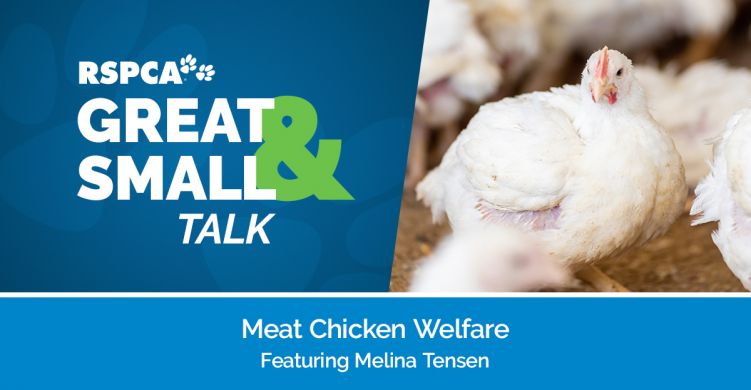
Brian: Hello, and welcome to RSPCA Australia's Great and Small Talk, where we discuss the pressing welfare issues animals face in Australia. I'm Brian Daly, and today we're talking about chickens, and specifically chickens farmed for their meat in Australia. And to discuss the animal welfare issues involved, we're joined once again by Melina Tensen, Senior Scientific Officer for Farm Animals at RSPCA Australia. Welcome back to the podcast, Melina.
Melina: Good to be with you again, Brian.
Brian: Now, chicken is the most consumed meat in Australia, and nearly 750 million chickens are farmed annually in Australia to meet that demand. Melina, that's a staggering number. Can you tell us how those meat chickens are actually farmed in Australia?
Melina: It is a staggering number, isn't it, Brian? I thought even though you said the podcast is about meat chickens, I think it's important just to talk about the distinction between meat chickens and layer hens because although they are the same species, their genetics vary, and this is because layer hens are well ... they've been selectively bred over many years to produce large quantities of eggs, while meat chickens have been selectively bred over many years to to grow large muscles. So they're your thigh fillets and your chicken breasts that you buy in the supermarket. So, as you say, the podcast is about meat chickens, not about layer hens, and it's I guess it's important to make that distinction.
So I guess your question: how are meat chickens farmed? Well, meat chickens are raised in large sheds, often holding 10s of 1000s of birds. They're placed in these sheds as day-old chicks, and over the next four to six weeks, so you know, a month and a bit longer, they grow to a size that they're ready for slaughter. And the floor of these sheds are completely covered in bedding, or also called litter in industry terms, which is made up of wood shavings or something similar, something soft for them to to stand on. And within the shed, you've got feed and water systems. You've got obviously temperature that's regulated, lighting that's controlled with light and different light and dark periods, and there's also ventilation. So there's fans and vents that manage air quality, and all this is done to manage bird comfort as well as promote bird growth.
Of course, most meat chickens are raised indoors in these sheds, but I think there's around 20% of chickens that are free range, so they have access to an outdoor range area, but all chickens, even free-range chickens, will spend at least their first three weeks inside the shed, and that's because, if you can imagine, little day-old chicks and even week-old chicks, they still have their down feathers, and before chicks can go outside, they need to have sufficient adult feather cover to be able to withstand the outdoor temperatures, so on free-range farms, chicks go outside at about three weeks of age when birds are reasonably feathered, and that's when they're allowed outside. So there's a bit of a difference between your free-range and your indoor-raised birds.
Brian: And what are some of the biggest misconceptions about chickens and how they're farmed?
Melina: Well, I think one of the ongoing misconceptions is that meat chickens are given growth hormones. Otherwise, you know, why would they get so big? And the other misconception is that meat chickens are raised in cages, and both these are not true. So many layer hens, as we mentioned earlier, not meat chickens are housed in cages, and clearly this is a serious animal welfare issue that needs to be dealt with. And actually, we have a great podcast on this topic, which you can find on our website. So, yeah, layer hens might be kept in cages, and the reason that meat chickens grow so big in this short amount of time is not because they're given hormones, but because they've been bred over many, many years to do exactly that. They've been bred to grow.
Brian: Yep, which they do extraordinarily quickly. Can you talk us through the welfare issues farmed meat chickens experience?
Melina: Yeah, well, so the key issue is that fast growth rate of these birds. The two main commercial meat chicken breeds in Australia have both been selectively bred for increased growth rate and body mass, and as I mentioned, these birds will reach slaughter weight in four to six weeks of age. So that's a very short amount of time. But unfortunately, this genetic selection for fast growth has meant that their bones can barely keep up with the rate at which muscle grows, and effectively they might struggle to support the bird's weight, and at the same time, the rapid increase in weight puts pressure on the heart and lungs. So, with these fast growing genetics, there's an increased risk of bone weakness, lameness, heart failure, other muscle conditions, and there's also an increased risk of higher mortality in these fast-growing breeds as well, and then as these birds get heavier as they grow, and if their legs can't support them properly, they're obviously going to be less active. They're going to be spending more time just sitting, and sitting means that they're in contact with the bedding or the litter, which is what contains all the birds' droppings. And if this litter isn't well managed, in other words, if it's not kept dry and friable, then the bird's skin being in contact with the litter results in painful ammonia burns to the bird's feet and to their hocks.
And also, I guess, if birds that are less active, they they're going to spend less time carrying out those behaviours that are important to them, like scratching in the ground and foraging and dust bathing and perching and all those things that a meat chicken likes to do. And in terms of other welfare issues, when you're thinking about the shed and housing conditions in the shed, these can also have a significant impact on on the welfare of the bird. For example, high stocking densities in the shed, in other words, the space that's available to the birds, can impact many aspects of meat chicken welfare. Well, quite negatively, I guess, because it can impact their ability to walk. They can develop skin lesions because of contact with poor quality litter, as I mentioned earlier. High stocking density can also lead to disturbance or more disturbance from other birds because you're constantly in contact with other other birds in the shed. Skin scratches, increased heat stress experienced by birds, and also if there's too many birds in the shed, then it becomes more difficult to manage that litter quality as well. And also in terms of housing conditions, if chickens aren't provided with adequate lighting, in other words, a light period for activity as well as a dark period to get proper rest. Or if they're not provided with good air quality, in other words, ventilation isn't managed well, or litter is managed poorly. All these conditions can also impact bird welfare.
Brian: So that's the experience while they're they're growing. What about in the slaughter process?
Melina: Yeah, so once chickens have reached slaughter weight, they're caught by hand. So there's catching crews that go into the shed and and catch these birds by hand. And sometimes, by the way, they use specially designed catching machines to do this. But generally, they're caught by hand and then placed into crates for transport to the abattoir, and so often the catching crews will actually go into the sheds multiple times over the life of the flock to remove just a part of the flock, rather than picking up the whole flock in one go. And this creates a lot of disturbance for the bird. And the practice of catching, particularly where birds are caught and carried upside down by their feet, which is pretty common, as well as the transport process itself. All this is pretty stressful for the birds.
And so, once they've been placed into their crates for transport, they go on a truck, and within a number of hours, they'll arrive at the abattoir. Once birds arrive at the abattoir, they're stunned. In other words, they're rendered unconscious so that they don't feel pain. They're stunned before slaughter. And so, in terms of the actual stunning process, there are two main stunning methods: gas stunning using carbon dioxide, and electrical water bath stunning. And for the electrical stunning process, chickens have to be removed from their transport crates and then shackled or hung upside down by their feet onto a system that then carries them into the electrical water bath. And the issue is when birds are held upside down, the weight of their organs presses up against their lungs and makes breathing difficult. And this is because, unlike us, birds don't have a diaphragm which holds everything in place. In contrast, for gas stunning systems, birds are not shackled while they're still conscious, but they remain in their transport crates, or they're transferred to a conveyor, which then takes them through the gas stunning system, where they they lose consciousness. So, in terms of electrical water bath stunning, I guess the animal welfare issues that I just mentioned-they're inherent to the system, as they they require inverting or hanging upside down and and painful shackling of birds that are fully conscious. And these birds, as they travel through the process, as they're shackled off the shackling line, they risk receiving painful pre-stunned shocks before entering the electrical water bath, and electrical water bath stunning systems also have a higher risk of birds not being stunned effectively compared to gas stunning systems.
Brian: So it sounds like there's a lot of welfare issues that are inherent in the system that need to be managed well, and I know RSPCA has been working to improve the systems over the over the decades, and so can you tell us what progress has been made to meet chicken welfare and how RSPCA has been involved in that?
Melina: Yeah, well, I think we saw real and and meaningful change when RSPCA Australia released the first meat chicken standard all the way back in 2010 under what was then called the RSPCA Approved Farming Scheme, now RSPCA Certified. I think before the standard was introduced, you'd see meat chicken sheds with gluggy litter, dim lighting, high stocking densities, and no perching and no enrichment for the birds. And now because of the Scheme and its adoption across the meat chicken industry, pretty wide adoption, I should say, chickens farmed to the standard have ... they more more space to roam and move freely. They've got that dry and friable, good quality litter, so that they can express those natural behaviours. They've got better lighting to encourage activity as well as periods of darkness, so that they can rest properly. And they've got enrichment and perches to to further encourage activity and positive behaviours. And so I think to date the improvements that RSPCA Certified has been able to make for chickens are pretty substantial, and definitely meat chicken producers participating in the scheme can be can be very proud.
But of course, we're not going to stand still. And progressing animal welfare is a process of continuous improvement that looks to the relevant animal welfare science, as well as you know those evolving community expectations and leading industry practice to see what more we can do to to make birds' lives better. So, in the 2026 edition of our Meat Chicken Standard, which we've just released, we've aimed to provide birds with more environmental complexity and an opportunity to experience positive mental states. And we've also worked on further addressing those important challenges relating to the handling of birds, the transport, and the slaughter of birds as well. And I'd say that among the most significant changes to to this edition of the standard are the phased reduction in stocking density, so aiming to give chickens more room to move and to move around freely. The phased introduction of variable light intensity, which will allow chickens to choose between brighter and darker lit areas in the shed, depending on what their preference is, and the phase out of routine electrical water bath stunning, which we just spoke about, and also for the first time, which is pretty exciting, the RSPCA Australia Standard for Meat Chickens also introduces requirements for producers wanting to raise higher-welfare meat chicken breeds. So instead of the fast growing breeds typically raised for chicken meat, these higher-welfare breeds they grow more slowly, they're more active, and their bodies cope better with their growth. And additional requirements for these producers growing high-welfare breeds include providing birds with natural light, making sure they have an outdoor area, giving them even more space, and we won't permit shackling of conscious birds at slaughter. So all in all, I think these are all, you know, pretty significant changes to the RSPCA Australia Standard for Meat Chickens, and will make a meaningful difference to bird welfare.
Brian: Yeah, that sounds ... really great improvements. And that's for birds that are raised under the RSPCA Certified label. What still needs to happen to improve the welfare for all chickens farmed in Australia?
Melina: Yeah, well, clearly not all Australia's chickens are farmed to the RSPCA Standard, and even then, there's always more to be done to ensure chickens raised for meat experience better welfare throughout their lives. And certainly, RSPCA Australia will continue to advocate at industry and government level to achieve this, and improving meat chicken genetics and encouraging that uptake of higher-welfare breeds is a key component of that advocacy. So, in Australia, the availability of slower growing meat chickens has been limited mainly because new genetics take several years to to firstly to import into the country and then to raise enough birds to have sufficient meat chicken to meet demand. And slower-growing birds also cost more to farm, and therefore result in a higher-priced chicken product at the supermarket. So I think consumer demand, and indeed consumer willingness to pay for the increased costs of production of slower-growing breeds would be an important trigger for increasing the welfare or increasing the availability of higher-welfare genetics in Australia, and of course, this is going to have significant animal welfare benefits because if all birds are bred and selected with a focus on welfare, with genetics that supports a strong, you know, healthy heart and bones and muscles, then effectively all meat chickens can live active, healthy lives. And then, on the regulatory side, we want to see a reduction in the legal stocking density limits. So we want birds given more space and minimum legal requirements around shed air quality and lighting and perching and enrichment for meat chickens, and of course we want to see that urgent phase out of stunning methods that require shackling of conscious birds, which is currently the case for electrical water bath stunning.
Brian: Yeah, well, they sound like great improvements to to be worked on there. And what can individuals do to contribute to improving meat chicken welfare?
Melina: Well, I feel like I'm repeating myself in every podcast, but nothing brings back that change faster than consumer demand. So, if you're keen on eating chicken and you care about animal welfare, then look for higher-welfare meat chicken products. And looking for the RSPCA Certified logo is, of course, the easiest thing to do. And if your supermarket or your favourite restaurant doesn't stock it, just ask for it. And finally, I think we need to see fast-growing meat chicken breeds gradually replaced with slower-growing breeds with improved welfare outcomes. And again, consumer demand is going to be vital for making this happen. So, again, as a chicken meat consumer, ask your retailer if they can source chicken from higher-welfare breeds. Just let them know that you're willing to pay more for better chicken welfare, and I guess that way too, you too can be part of a sustainable future and give meat chickens in Australia a better life.
Brian: Well, thanks, Melina, for for joining us today and giving us this update on the welfare of meat chickens in Australia. Again, the the sheer number of chickens farmed in these systems means that this welfare issue has enormous implications for, as we've discussed, millions of individual sentient animals. So it really does deserve all the attention we can give it to improve the conditions for these chooks, and we can all play a part in that, as you say, by looking for that higher-welfare chicken and be willing to pay a little bit more, so that we can give these chickens a better life. So, thanks for your continual work in this area.
Melina: Thanks, Brian, and thanks to those who've listened.
Brian: We've been talking today with Melina Tensen, Senior Scientific Officer for Farm Animals at RSPCA Australia, and thank you for listening. If you would like to find out more about the animal welfare issues associated with meat chickens, you can visit RSPCA Australia's website at rspca.org.au or the RSPCA's Knowledgebase at kb.rspca.org.au. You can also subscribe to the podcast series at the RSPCA website, or any of your favourite podcasting platforms. I'm Brian Daly, and I look forward to your company next time on RSPCA Australia's Great and Small Talk.