Transcript
Sarah: There is this growing recognition from science and community to recognise that animals can suffer, but at the moment, I think those protections are still largely framed within a system that prioritises human use.
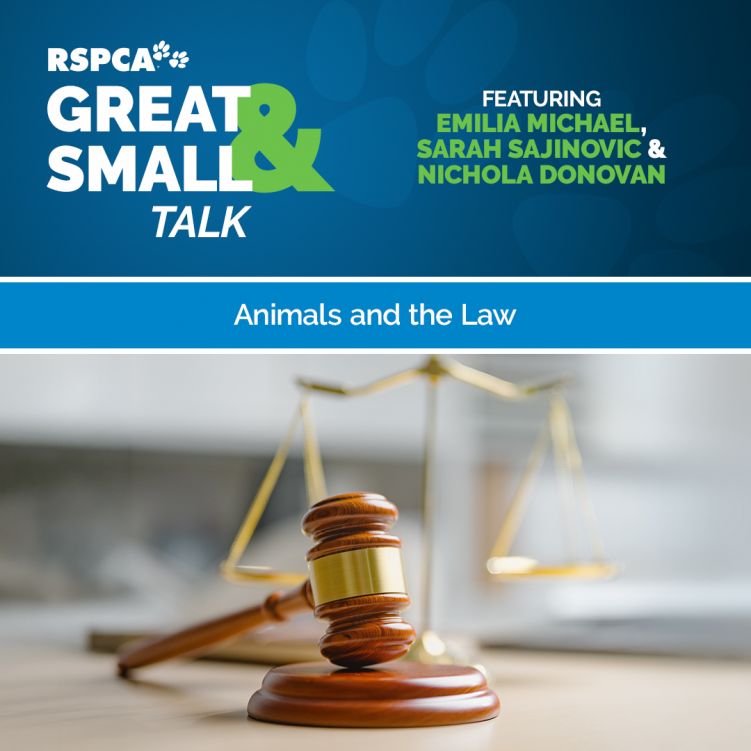
Brian: Hello, and welcome to RSPCA Australia's Great and Small Talk, where we discuss the pressing welfare issues animals face in Australia. I'm Brian Daly, and today we're talking about animal welfare law in Australia, how well our animals are protected under current law, and where there is need for improvement, how the law can be utilised to improve outcomes for animals around the country. And to provide their insight into this important topic, we're joined by three legal experts in this field. From Lawyers for Animals, we have former president Nichola Donovan and current co-president Sarah Sajinovic, and Emilia Michael, Advocacy Director and General Counsel at Action for Dolphins. Nichola, Sarah, Emilia, welcome to the podcast.
All: Thank you. Thanks for having us, Brian.
Brian: Firstly, as lawyers working in this field of animal welfare, how do you go about using the legal framework to advocate for animals?
Sarah: So yeah, Nichola and I are at Lawyers for Animals. We are a small volunteer-based organisation here in Victoria, and we try and improve the welfare of animals through both education and the law. Some of the things we do is assist other animal welfare groups with their work, develop educational materials, publish articles, prepare and submit submissions to all kinds of policy. And one of the main things that we're quite proud of is providing a animal protection legal clinic in combination with Fitzroy Legal Service, which Nichola has been a part of for a really long time.
Nichola: Yeah, we run the animal protection legal clinic where our volunteers are able to give legal advice to people who are eligible for the clinic, whose interests coincide with that of at least one animal, and that clinic is basically set up with Fitzroy to advance or promote animal welfare. We also undertake educational activities, events, and so forth, and we write submissions where we have time. We really like to use our legal knowledge to try to advance reform and improve things for animals.
Brian: And Emilia, how do you go about using your influence?
Emilia: Brian, at Action for Dolphins, we're all about using the legal framework to try and protect dolphins and other marine animals from harm. So there's two key ways we use the legal framework. The first is law reform. We identify where there's a failure in the law. We use an evidence-based framework to show why that law should be changed, and then we mobilise. We mobilise like-minded organisations, academics, and our public supporters to show key decision makers why there's a push for that law to change. That's the most common tool in our toolkit. The other is litigation or the threat of litigation. Now, this is one we use rarely for two key reasons. Firstly, it's really hard to use this successfully to achieve the outcomes you want, which is often greater protections, and secondly, it's quite costly. You have to get pretty creative if you're going to use litigation as one of the tools in your toolkit. And that's all to say that the law is the framework under which we operate. But ultimately, it's about bringing people along on the journey. And if we can ask decision makers to meet us and the public where we're at. That's what we're going to go for first.
Sarah: Because Australians would like to think, you know, we look after our animals pretty well and assume that we have good animal welfare laws and protections. But how accurate is that perception?
Emilia: So if we think good means that animals are protected based on their intrinsic needs, both their welfare needs and their desires. Then I think the answer is no. I'm going to give three key reasons as to why. The first is at its core, animals are property. They're things. They're the same category as your couch, your lamp, your car, and they're distinct from humans and companies. And humans and companies are legal persons under the law, so the relationship is odd. Animals are then defined through their welfare needs based on the human perspective, how humans categorically use them. So we see this come out where companion animals, our pets, often have higher protection welfare than, say, animals used as a resource for food, for their body parts, whether it be in research or for their skin or their wool, or animals used for our entertainment. The same weird dichotomy happens for wild animals. So wild animals under the law are effectively unowned until we find them or consider them a resource. So we want to use them for their bodies or entertainment, or they're considered a pest. So we take steps to eradicate them, and then you've got this fragmented system all over the place. So we've got states and territories that treat them differently, and so the same animal can have different treatment depending on where it's used in Australia.
Sarah: Yeah, well, I pretty much concur with you, Emilia. I think you know our animal welfare laws aren't very good at all. They're very outdated. I think in all of our states, I do acknowledge the ACT recognised sentience in animals, but even then, it's not very substantive in terms of what's actually happening. And what you said, Emilia, the crux of the whole thing is that animals are considered property, which inherently means that they they don't have rights or anything. So it is quite difficult to advocate for them when the premise of it all is that they are a thing, not a legal person, as they say.
Sarah: And so you mentioned the ACT laws of sentience, but that's the only example we have of it being mentioned. Is there is there any meaningful legal sense to that recognition?
Nichola: I would say that no, it doesn't, because mere recognition of sentience, that is the ability to feel pain, and for that matter, to feel happy, just to to feel sensations that are either pleasant or unpleasant. Just because that is recognised does not mean that the law then protects against the imposition of those sensations by human beings. So, for example, in other jurisdictions and in the ACT, animals are still killed for food. For example, and we assume that when they are being killed, or even when they are being shocked before being killed, they are feeling unpleasant sensations. Not to mention the fear that they would experience in the slaughter process, and that's just at the far end. There are so many other ways in which animals can be unpleasantly dealt with, and in ways that might be not rationally necessary, even though they have been recognised as sentient. And interestingly, the ACT law doesn't include animals such as insects, and recently there's been some really interesting science developments suggesting that crickets, for example, are sentient. So yeah, the law often lags a long way behind science on these things.
Brian: And I guess this goes back to that that point that the animal protection in Australia is fundamentally shaped around animals' usefulness to humans rather than their intrinsic value.
Sarah: I think you can see it in the structure of legislation. Our anti-cruelty statutes are quite broad, but they're all very heavily qualified by exemptions and industry codes, especially in agriculture and research, so the level of protection often depends less on the animal's capacity to suffer and more on the context in which an animal might be used or is considered useful. So there is this growing recognition from science and community to recognise that animals can suffer, but at the moment, I think those protections are still largely framed within a system that prioritises human use. I would say we're in a bit of a transitional phase where these concepts of intrinsic value and sentience are emerging, but yeah, we're still operating within a framework that is at its core human-centered.
Brian: And also, you know, mentioned before about the lagging behind of the scientific understanding of sentience or suffering, and what happens when you know when we're in this spot, if you if you will.
Sarah: I would say you tend to see a gap between what we know animals experience and then what the law actually protects. So in practice, I think that means lawful activities can still cause significant suffering, and they do simply because the legal framework hasn't caught up yet. I think it leads to some inconsistency. Some animals or industries are protected more than others, and it's not because of science. It's ... it's more because historical and economic factors, but yeah, I think importantly it weakens enforcement and accountability, and I think the lag in the law can result in a loss of public trust when it feels out of step with modern science, and I think scientific developments often become the catalyst for reform, but there's typically a big lag. I mean, the law is notoriously slow in being updated. In in one sense, it's sort of necessary because I guess legal reform needs to be appropriately considered, and we can't just be passing laws too quickly and they end up being bad and wrong, but then yeah, equally it ends up taking so long for many laws to come in, and then it means that we're stuck with existing not so effective laws that feels out of step with science and community expectations. And I think animal protection laws certainly in that category.
Brian: Yeah.
Nichola: However, there are laws that are being used every day that effectively recognise sentience of animals, but without using that sort of terminology. For instance, the Domestic Animals Act provides that where there have been offences relating to ownership of a dog who has attacked and caused injury to another person or animal. There is a defence applicable where the dog was being teased, abused, or assaulted. Now, just recognising that a dog can be teased or abused suggests recognition that the animal has a capacity to feel suffering or pain. So yeah, we're already recognising this. The Family Law Act has recently made some changes nationally regarding the animals in terms of property settlements. So where relationships break down and there's a dispute over the ownership of the cats or the dogs or other companion animals. There's been a change in the law to allow all the courts to make decisions about the animal not just based on strict sort of property type criteria, but to consider them a sort of a form of semi-property, but different to the furniture and the house and so forth. So you're now looking at who cares for the animal, who has cared for the animal in the past, who has the basically a strong bond, who has shown responsibility. These sort of things are being looked at in the law. And then we've got the Prevention of Cruelty to Animals Acts around the country, these are considered welfare laws. So they're about humans wanting to provide for less cruelty for animals because we think that that is a bad thing. But that would be, in some sense, recognising again that animals feel pain and suffering.
Brian: Which sounds like a good place to start, and those ... those companion animal examples you mentioned sound like things are slowly moving. As we mentioned, that does take a long time. But why is it do you think that companion animals often receive these stronger protections rather than, say, as mentioned, the farm animals or ... or animals used for sport or entertainment?
Nichola: When I was quite young, attending university at Monash, I had a lecturer named Professor Peter Singer who taught me about a new phenomenon I'd never heard of before, called speciesism. And he basically challenged us one day by saying, "Why do we love our dogs and care for our dogs so much, but then treat pigs who equated in terms of their intelligence and actually their personality features and other features? Why do we treat our dogs so well, but then eat or kill and eat pigs?" And yes, this caused a huge change in my thinking around why I act in certain ways. So speciesism, which is a prejudice that people feel towards animals, where they differentiate themselves from animals without having regard to the similarities they actually have with animals in terms of, for example, the way in which humans feel pain. Well, humans are just a class of animals, really. So the way in which we feel pain is going to be very similar to the way in which certainly the mammals feel pain because we've all come from the same ancestors basically, and ... and we excrete the same hormones when we are trying to control our pain. Even fish will excrete cortisol to try to control their pain and suffering, which humans do as well. So yeah, I think the question of why people can, for example, recognise the sentience of animals and yet still feel that they have the right to not only control but harm them and use them for industries and ... and to eat, for that matter, is probably because of speciesism.
Brian: And tell me, how do legal exemptions work in animal welfare legislation? Because we're talking about the differences between different areas of, you know, the way, for one better word, humans would utilise animals. There, why are there legal exemptions? Are there practices currently exempt from cruelty laws simply because they're considered the standard industry practice?
Nichola: Yes, there certainly are. It was actually quite a revelation for me as a lawyer to come into the animal law field and discover that the the very acts that are designed to protect animals are actually the acts that the government uses to exclude certain classes of animals from real protection. So, section six of the Prevention of Cruelty to Animals Act in Victoria specifically says that this act does not apply to, for example, the slaughter of animals. It also exempts all farm animals from protection from the Act. It works in a way that the farming, transport, sale, or killing of any farm animal that is carried out in accordance with the Code of Practice is exempt from the cruelty laws. So, provided that you're following the Code of Practice, which tends now to be in regulatory form, and it is created by a committee which is formed mostly by animal industry groups, so it's a bit like self-regulation. They come up with their own standards, and so yes, we do find that there are standards which are just considered normal for the animal industry, and these are applied regardless of whether or not they are cruel or can cause unnecessary harm and suffering to animals, and those standards will then be exempt from application of the Act. There are other exemptions within the Animals Acts around Australia for animals to be used in sport and entertainment, and where those animals are, for example, under the regulation of a sporting industry body such as a racing body, then they don't have the protection, the ordinary protection of the inspectors under cruelty to animals legislation.
Brian: And you've mentioned there about the Victoria legislation, and that's happened in ACT. The fragmentation of animal protection laws across Australia that must create all sorts of problems for, as as you said, some states animals will ... will be treated one way and then cross the border, and they'll be treated entirely differently.
Emilia: So, Brian, it presents problems in a few ways, and so I'm going to gain the example of dolphins across Australia, across state and territory, and ... and Commonwealth borders. It's an offence to feed or to touch or to closely approach wild dolphins, and this is based on the welfare implications we know. We know that wild dolphins who get too accustomed to human interactions get quite close, it can increase their risk of injury from entanglements of boat strikes, and it keeps them closer to humans. So it reduces what's known as their home range, and that can have implications for them when food becomes scarce or there's a climate change impact, which means they need to move outside that range. But then you've got some exemptions for wild animals in Queensland and in Western Australia. You can go to designated spaces and feed wild dolphins, or watch tourism operators hand feed wild dolphins. The same welfare concerns exist. In fact, it's even more concerning because as much as 10% of their diet through these hand feeding programmes can have other welfare implications, including between the mother and the calf bond. They're exempt and they're legalised. Then, if you go to Queensland or New South Wales, you can swim or touch a captive dolphin in a marine park, and that's because they fall under the exhibit animals type protections. So again, that it's legalised and promoted to do these negative experiences for the dolphins.
Brian: The same species (same species), different outcomes. I guess Australians will be shocked when they know about these practices, and you know the the differences in the states and the differences in the legal standards governing certain industries. Do you think that that would be the case? You know, because we probably think that that the animals are generally covered well and and consistently across the nation.
Emilia: Yeah, I think you're right, and the shock value often changes, and the key question for me for me is: does that shock value actually translate to a change in behaviour?
Brian: Yeah, good question. I guess there's a there's a gap that the public would have there, and what makes people jump that gap in where we are, where we understand, but actually what we do in practice.
Nichola: I think there is a big gap between the animal cruelty laws that exist and what they do in practice, in part because the enforcement is marginal at best. We also have an enforcement system where animal industry is only subject to enforcement by government bodies. I don't mean police forces who are geared towards enforcing laws very strictly and ... and honestly, I'm talking about the enforcement of animal standards and practices by bodies within the Departments of Agriculture in the various states and territories. So there is such a big conflict in having a body that is supposedly enforcing the anti-cruelty laws say in farming practices as a sub-body of the Department of Agriculture. It's it's just probably one of the biggest problems that we face in terms of going forward and trying to improve the system because there is just this inherent inbuilt conflict between who controls how the laws, what laws are made, how the laws are made, and what their personal interests are, what their profits are driven from.
Brian: And I guess people too would often equate legality with morality. You know, when it comes to animals, it's legal, therefore it must be okay. But obviously, that isn't the case. Something can be legal, and still clearly, as ... as the the examples you've already illustrated, can clearly be harmful or cruel to animals. But it still can be legal. You must come across this all the time in your work.
Nichola: Yes, I do. And again, it's one of those things that when you start out as a lawyer, you think that you are going to be able to come into a field or an area where your morals, your ethics, are going to be reflected in the law. And I think before we study this in detail, we all have a fairly rosy picture that the law is going to reflect what we think is right and what is wrong, and therefore what is cruel will be outlawed, and what is not cruel won't be. And then we discover conflict of interest and the other interests that are totally undermining the morality of law. So it might be surprising to people to realise that, for example, dogs and puppies, cats and kittens can be bred in ways that would absolutely offend the the notions of morality of I think the vast majority of the Australian public. They would not want animals to be kept caged in small areas, barely exercised, barely socialised, barely given any kind of emotional support and love when they are, yeah, people are deeply connected to their dogs at home or their cats at home, and they would be horrified to know that these things are legal and yet it's all allowed and it's all supported, and people still continue to purchase animals from such breeding facilities. They ... they possibly, I think they may not understand where they're coming from. I think there's a lot of misinformation about the benefits of purchasing an animal at an early age from one of a breeding facility rather than than rescuing an animal from a pound that might already have had some bad experiences, that people see that an animal might be already damaged before it comes to them. That might seem like a real negative to that person. They don't seem to understand that animals are extremely resilient and wonderful creatures, and that they can forgive humans amazing ill treatment in the past, and in fact, be well extremely unspoiled, wonderful companions in the future if they are rescued.
Brian: Well, I can attest to that from my own personal experience. You talk about the the gaps in knowledge, and you know where the public is perhaps not seeing the full picture, but are there also examples where public opinion has evolved faster, obviously, than the law has, for instance?
Emilia: When we're trying to change the conversation around animal protection, the first thing we do is just get a sense check on how a cross sample of Australians are feeling about it. So, one example is we're advocating to introduce a breeding ban of captive dolphins and polar bears in Queensland because Sea World is the only facility that continues to breed them for entertainment. And we're arguing this based on the latest scientific evidence on welfare grounds, so evidence has shown us that they're long-leaved species and they've evolved for very complex environments. But captivity restricts them on being able to express these natural behaviours in the long term. So they live in spaces that are a fraction of the space that they go to in the wild. It simplifies their habitats. Yes, they have enrichment, but they're not exposed to say the rich Arctic or the diverse ocean like they would be in the wild. And they've got quite unique, you know, social behaviours. Dolphins, by their very nature, are quite social and they're large pods, whereas polar bears tend to operate more so in isolation. But when they're in captivity and they're in small spaces, that's restricted and managed. And marine parks are really loud, and they have incredible sense of acoustic behaviours, and so that environment is very different to them in the wild. So for these reasons, we say marine parks have structural welfare risks, and for that reason, we don't believe any future generations of dolphins and polar bears should live a life of captivity. So, to release the science-backed information, we went and conducted a national survey, and it was an independent survey of just over 1,000 Australians. What we found is 80% of Queenslanders and 79% of Australians find it extremely unacceptable or somewhat unacceptable that polar bears are kept in captivity at Sea World, and a majority of Queenslanders and a majority of Australians also feel the same way about keeping dolphins in captivity. So we took this information to decision makers, both at Sea World and in the Queensland government, and to date, neither have been receptive with a breeding ban. But we've seen that these types of sentiments have shifted in New South Wales, where a breeding ban and an importation ban for captive dolphins does now exist. So we are hopeful that the law will catch up to public opinion.
Brian: Do lawmakers tend to wait for overwhelming public pressure before acting on these issues? It seems there has to be this massive movement to to get things moving.
Nichola: Yes, I would definitely agree with that one, Brian. It's definitely been the practice of politicians in the animal welfare realm. The duck hunting issue is a case in point in Victoria. So we've got around two out of three Victorians opposing duck hunting in Victoria. Yet, when it came down to the final decision by the Environment and Department of Agriculture Minister, they decided to allow it in spite of their own people on the Parliamentary committee deciding that it should be in fact banned. So, this is yet another example of how long it is going to take to achieve even these small advances, which seem so obvious and which the public supports so strongly. However, I don't lose faith because there's always been this history of delay, delay, delay by politicians, even in democracies. So I do not lose heart, and I do believe that it is inevitable that there will be recognition of basic animal rights. But yes, it is a slow, long battle, and the lawmakers do tend to wait until there is massive pressure from the public before they will act.
Brian: So there's a lot of lot of barriers there to, you know, you're talking about political barriers and industry barriers and legal barriers to changing animal protection laws in Australia. What's the biggest challenge you think to to changing laws in Australia?
Nichola: That's a good summary. But yes, I think that the crux of the whole issue is philosophy. It comes down to how we think about whether or not we are going to make changes in our own lives to allow us to live more in keeping with our consciences in what we choose to purchase, in what we choose to consume, and in who we choose to vote for.
Brian: We're living in the age of social media now. Has this changed legal conversations at all? Have have there been any laws updated or new laws developed in response to animals and social media concerns?
Sarah: I don't think in Australia there's been any standalone animal-specific legislation yet in terms of using social media as a means to facilitate or show animal suffering. There was earlier this year a bill in Victoria, and it addressed in relation to the Crimes Act, prohibition in relation to the creation, possession, distribution, and accessing of animal abuse material. So, kind of the extreme end of things. And then, yeah, on the flip side, we've seen I think like the Farm Transparency Project litigation is an interesting example where we've seen courts uphold restrictions on publishing covert footage obtained through trespass or surveillance laws, even when this footage is intended to reveal animal cruelty concerns, and that it's been publicised on social media and other platforms. At the moment, the High Court's grappling with questions around copyright and injunctions, implied freedom of political communication in this context, essentially asking whether the law allows practices to be filmed and shared at all. So, yeah, I'd say social media has changed the conversation, but in Australia, it seems less about expanding animal protections and more about regulating, or in some cases limiting, the visibility of animal suffering.
Nichola: This is another major barrier to the change in animal protection laws in Australia, which is the absolute strength and lobbying effect of the animal industries and their ability to then generate regressive changes in law, perhaps.
Brian: Yeah, yeah, it was an interesting case. We ... we talked a lot about the barriers and the gaps and the need for change. Is there any area in Australia where we've made meaningful progress on animal protection, or what are some of the reforms or legal developments that give you some hope?
Sarah: I would say that yes, there is some progress. I think it's overall very incremental rather than structural, and definitely more needs to be done. But you know, conceptually, the ACT's explicit recognition of animal sentience, as we've discussed already, is a sort of trending towards this gradual shift in how the law understands animals as being capable of suffering and not just property. But I would I would say one of the more interesting recent developments is in the family law context. Nichola did speak on this a little bit earlier, but courts are now required to treat pets as companion animals and consider factors like welfare, attachment, and even family violence when they're deciding disputes. I think that's a pretty notable move away from a purely property-based approach. But animals still do remain legally classified as property, even in this family law context. So there's definitely scope for more to be done, but I guess we seem to be heading in the right direction. And yeah, it is a nice reflection of recognising animals as being an inherent part of our lives, and that they aren't just an inanimate object, essentially.
Brian: Yeah, yeah.
Nichola: I came into the field of animal law in 2006 when I joined Lawyers for Animals, and in that time, I think I have seen some meaningful progress on animal protection, and that is what gives me motivation to keep going. I know that there are times when we all just feel like we have to give up, but the current enormous surge in animals requiring rescue and the pressures and the difficulties in finding good homes are just hugely problematic. And yet, there's been meaningful progress in terms of the protection of those very animals, in terms of the breeding laws in Victoria, where there were major changes made, which required the registration of all animals before they are transferred by sale, and that means that the breeding facilities are much more able to be traced now. It also enabled the Victorian government to outlaw the sale of pets through, or dogs and cats at least through pet shops, which was promoting sort of thoughtless consumer purchases, which weren't really going to feed into the long-term care of animals. And there's also been progress in terms of pet shops, then not being able to sell animals from ... from breeding facilities, then being able to sell animals from rescue. So, this is again promoted more rescue. So companion animals has been real progress in the farm animal field, and let's face it, farm animals are the vast, vast majority of animals in Australia. So, on the farmed animal frontier, I've also been privileged to see some improvements. For example, in the outlawing of certain intensive farming practices, we are gradually phasing out things like style stalls, and there are more incremental changes that I've seen come through the the local Acts in Victoria over time that I've been working here. Some that Lawyers for Animals itself has proposed, like the outlawing of steel-jawed traps for animals. So yeah, just from little things, big things come.
Brian: And what can people do? You know, say they're concerned about animals. What what can they do if they want stronger animal protection laws?
Emilia: I think individually we can take actions that help form the collective. And I know it sounds cliche, but actually your voice in the decisions that you make are actually incredibly powerful. So find the cause you're really passionate about. Connect with the organisations that are working on it, and they'll help guide you through it. It can take anywhere from 30 seconds to 5 minutes to either write a letter to your local MP or make a submission to a Parliamentary inquiry when it's open. And while you might be one individual, there are 1,000s who feel exactly the same as you do on that exact same issue, and those numbers matter because those organisations can show that there is a cross section of the community that want this to be a priority. The second is the consumer choices that you make matter, so match them to your own values. And the additional step is actually tell either the supplier or the manufacturer why you did or didn't make that consumer choice, and they rely on real-time feedback from consumers. So getting that feedback front and centre helps guide what they are or aren't going to do in the market.
Brian: Yeah, you can certainly make a difference with with how you consume, there's there's no ... there's no doubt about that.
Nichola: I also think voting ... voting is just so crucial because even though we might give our secondary vote through preferences to one of the major parties, we can give our primary vote to a party that might represent our interests more strongly, because if you give that primary vote to a party, that party can then obtain funding through the electoral commission to continue its work and feed into the parliamentary processes. And also, they people can get involved in the major parties and lobby or advocate for animals in their major parties, and yeah, I think voting and getting out and supporting the the political parties who reflect your views on animals is a really good way of helping to achieve change. And I certainly concur about consumer change, and as a vegan at present, I have seen massive changes in the supermarkets alone, but in all shops and restaurants and so forth in terms of the availability of good, healthy, but really, really tasty gourmet vegan food over time. So that also gives me hope that we are gradually making some progress here.
Brian: Well, that's a great note to end on, and I'd really like to thank you all for joining us today, Nichola, Sarah, and Emilia. It's been a wide-ranging and very enlightening discussion, and to get your perspective on the state of animal welfare law in Australia and where we need to look at implementing changes to improve those laws and to actually protect all animals in Australia consistently across the board, I think the time is certainly ripe for that change. So, thanks for your time and all your work as well for so long in advocating for the legal protection of animals. So, thanks for joining us today.
All: Thanks, Brian. Thank you (inaudible) Brian.
Brian: We've been talking today with former president of Lawyers for Animals, Nichola Donovan and current co-president of Lawyers for Animals, Sarah Sajinovic, and Emilia Michael, Advocacy Director and General Counsel at Action for Dolphins. And thank you for listening. If you would like to find out more about animal welfare law in Australia, you can visit RSPCA Australia's website at rspca.org.au or the RSPCA's Knowledgebase at kb.rspca.org.au. You can also subscribe to the podcast series at the RSPCA website or any of your favourite podcasting platforms. I'm Brian Daly, and I look forward to your company next time on RSPCA Australia's Great and Small Talk.