Transcript
Elaine: For some reason, animals that seem untrendy, unattractive, unwanted are totally neglected just through lack of policy or action. Just because you're not pretty enough, you should ... you should be also treated as a sentient being.
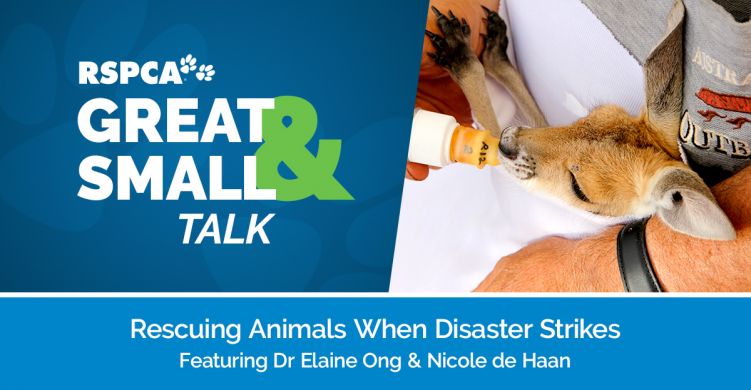
Brian: Hello, and welcome to RSPCA Australia's Great and Small Talk, where we discuss the pressing welfare issues animals face in Australia. I'm Brian Daly, and today we're talking about what happens to animals when disaster strikes. Whether it's weather, crises, domestic situations, homelessness, animals are often the victims that fall through the cracks. And to discuss what happens in these tragic situations, we're joined by the founder and CEO of the volunteer response organisation Vets for Compassion, Dr Elaine Ong, and her colleague Nicole de Haan, Operations Manager at Vets for Compassion. Elaine and Nicole, welcome to the podcast.
Both: Thank you. Thank you for having us.
Brian: Now Elaine, if I can start with you and your career, you've been there responding to some of the most devastating disasters the country has faced in recent times. The Lismore floods of 2022. You were a first responder at Mallacoota in 2020, the 2009 Black Saturday fires, as well as working overseas and deservedly receiving the Order of Australia Medal in 2023, but for those unfamiliar with your incredible work, can you tell us a bit about yourself and what drove you to pursue veterinary medicine and animal welfare?
Elaine: Hello, Brian and everyone. I've always wanted to pursue medicine of some sort. Even as a young, as a child, I thought I would become a doctor and open a free clinic. And obviously, it's not practical to do that. But I think I decided to do vet med science because I love animals, and everybody wanted me to do medicine. So I thought I'll do the opposite. As far as animal welfare is concerned, I was born in Malaysia, and my parents sent me here to pursue my tertiary education, and I was one of the lucky ones to receive a subsidised education. If not for that, I would not been been able to do this here. So I strongly believe that I should pay back to Australia what I've taken, and hence I decided to sell my business earlier and pursue this the work that Vets Compassion does.
Brian: And as you said, you spent decades working as a vet, and what was the moment that you realised that you needed to set this up, that the the resources weren't enough, and then there was a need for this Vets for Compassion to be founded?
Elaine: Well, locally, I was working as early as 2003 just as a dog's body, just going around to fires. In those days, there weren't any rules or regulations about helping in disasters such as bushfires. So I was just tagging along with other rescue groups to help in fires. I saw kangaroos on fire, literally, and the distress and the suffering, and that was when I decided to get my dart gun licence because that was the way we could capture those animals in distress. And I also felt that over the years, for some reason, animals that seem untrendy, unattractive, unwanted are totally neglected just through lack of policy or action. Just because you're not pretty enough, you should ... you should be also treated as a sentient being. Overseas and locally, I mean, we still have daily disasters going on on the road. It's not just a fire or flood. Every day, kangaroos are being pushed out of their habitat and they're getting hit on the road. It's a disaster for not just the animals, but for the public as well. And it's easier to ... it's easy to work alone. But we ... we started Vets for Compassion because we're much stronger as a team. We can teach, we can train others, so that the focus should be long term, not short term.
Brian: And Nicole, how did you come to be involved in Vets for Compassion, and ... and what's the goal or the ethos that that the team works under there?
Nicole: Yeah, so I came to Vets for Compassion ... I had been in the veterinary industry since high school, actually, and I grew up in the country on a farm, so I've been around animals my whole life. And I'd worked in a GP clinic for a long period of time, and then moved down to Melbourne and stepped into a really big busy clinic here. During that time, I felt like I had the skills, and I'd learnt the skills, and had the experience to put those skills and that experience into something that meant more. Because I did a lot of work overseas, voluntary work overseas in places like India, and it really ignited that passion for me. And I was looking for something locally here in Australia to get involved with that I could do more regularly, rather than once or twice a year overseas. So Vets for Compassion came about. The owner of the clinic knew Elaine, and he was aware of Vets for Compassion, and I was very mindful of putting my time into something that was meaningful, but also with an organisation or group that was an action group, and that's one thing that stood out to me with Vets for Compassion is that what they said they would do, they would do. And then 2019 fires came about, and there were supplies that were required at short notice, and that was something that I was like, "Well, that makes no sense. Why are they waiting for that? I can get that to you in an hour." So I kind of jumped on board. My husband actually dropped supplies off to their home that morning, and on they popped on a plane, and off they went. And it was just full steam ahead. Was sort of thrown in the deep end with fires, and yeah, have never looked back.
Brian: And I guess you are thrown in the deep end all the time, and you often attend rescues that other organisations are unable to. So you could tell us how about those barriers and how you are able to overcome them and navigate through them?
Elaine: I think it's because we we succeed because we have trained teams, we are ready to respond very quickly. We have our triage kits ready to go. Our team are trained almost every day anyway with cat, dog, kangaroo rescues. We communicate regularly, so we almost because of that ... that training, we are ready to respond. It is ... it is costly and time-consuming, but with with that team, we make it.
Nicole: I think that's her compassion were built on the need and and built to sit in in the gap that didn't exist. And our organisation, the ethos, I guess, at the end of the day, is that that we go and where we're needed, regardless of species, circumstances, and complexity. We do cover all species, which does differentiate us from other groups and orgs, and and we are a veterinary org, so that also it means that that we can respond quicker, and we have the right people on the ground when needed. And quite often, we'll go to places and respond to animals in need that that others aren't able to get to or go to. And we probably operate a little bit differently, like Elaine said. You know, we're ready to go all year round, and and they do this work day in, day out. This is a seven day a week, 24 hours a day job for these, or not even job, but it's a role for ... for the team. And Vets for Compassion's been built to be flexible, and like Elaine said, that they're trained to handle all different types of species, not ... not just one. You know, complex environments, high risk situations, and we operate a little bit differently. We're able to make rapid decisions and mobilise really quickly without, I guess, bureaucracy or maybe the structure that some other groups abide by. We have a little bit of flexibility there, which I think definitely helps.
Brian: And as you say, Elaine, the disasters are happening every day, small and large. So you're always ready to go because you're you're doing it every day. And how do you make those decisions in those high pressure moments where you know something major happens and and the outcome for the animals are uncertain?
Elaine: Well, obviously we select our team very carefully. People who work on a daily basis, in in rescues are selected. They are trained. Everybody runs through a six month probation, but they have to be incredibly calm. We have obviously we have in a disaster we have vets who can help make decisions, but they have to be also trained to, for example, look at burns using binoculars because you often can't get close to the animal to see, and a lot of our rescuers also are highly experienced on animal behaviour. We can tell by the behaviour, by the look through binoculars or not, whether we need to capture that animal. Obviously, having a large number of darters in our team, we have about 14. Tranquilliser guns are expensive, but they are incredibly helpful because you can tranquillise the animal with little stress to the animal and to the people. Yes, and keep them asleep nicely so you can examine them. So that is a highly, highly beneficial tool. In the city where we have high pressure moments where we are in a primary school, in a shopping centre on the eastern freeway, where there's a kangaroo or a deer. That's poor things are, you know, hopping or running for their lives. Cars and people everywhere. We have to stay calm and assess the situation and try and capture the animals safely without causing any accidents or you know any mistakes. So yeah, it's ... it's really the training that matters for our team.
Brian: And you collaborate obviously working with governments and volunteers, other organisations. Where does that succeed, and what's what are the issues there, or or how do you how do you overcome any issues that might be present in those situations?
Elaine: I'll let Nicole answer part of it, but what we've done is it is a big part of us. How I started it is always about collaboration. We've trained other people. We've even trained people, darters from other groups and organisations to dart without expecting anything back. The ... the projects in China and Lismore, for example, a huge collaboration that succeeded well. In China, we it was a train the trainer project. We never meant to be there long term. It's about handing it over. The collaboration was massive. You know, it was the provincial government, the vet association, the local shelters, the carers, and the universities that worked really well. In Lismore, we collaborated with the their Department of Ag, and there was such a successful collaboration where we were really there to. We're not there to take over. You know, we're there to assist them. We assisted the local vets. All three clinics were submerged in Lismore, so we were there just to assist the farmers, to assist the the local vets until they were ready to to take over. Nicole?
Nicole: Yeah. Look, I think collaboration works so well. It's incredibly powerful, and we strongly believe that. The outcomes happen when when different organisations bring strengths together. So you know, emergency services and vet groups and community responders, and and just the community in general, we we definitely can't do it alone. Like Elaine said, we don't respond to disasters with the with the goal of of taking it over, and we do go there with the intention of definitely working with everybody together. That's that's one thing that we we tell our team from day one. We actually can't do this work on our own. It's not just the guys that are in the field. There's, you know, support teams behind the scenes. There's other people on the ground that may not be vets that are doing other work. It's about working with the community. We need locals to help. We need emergency services. It actually can't be done on our own.
Elaine: I recall working with the RSPCA of Victoria during the Black Saturday fires in Kinglake, we were actually working for quite some time, nearly four months. But this particular effort in Kinglake, we were the vets for the RSPCA of Victoria. It was good to collaborate with them because the inspectors had powers to enter property to rescue, or you know capture animals, and we we don't have those powers.
Brian: So as you say, Nicole does rely on an effective cooperative kind of model.
Nicole: Absolutely, yeah. It's definitely you know the model of the future. I guess at the end of the day, animals don't fit neatly into categories, and and neither should the response systems. I think yeah, for it to be successful and to be the most successful it can be, it does require working collaboratively with everybody and and property owners getting access to owners so that we can get to more animals. Like all of those things come into play.
Brian: So, do you think the way Vets for Compassion is operating as a temporary gap, or is it revealing that there needs to be a more structured approach to how we care for animals in these situations?
Nicole: I think that we're filling the gap that is there. I think it's a long-term gap, and whether that is us that fills that gap or whether somebody needs to, but it's definitely highlighted the need for it and the demand for our services is is growing on a daily basis as well as disaster response, if there wasn't a need for it, then none of us would be doing this. But it's growing every week; it grows and grows and grows. So I think it's a it's definitely a structural issue, and I do think that that that certainly does need to to change in the long term. I think it's definitely ... it does highlight a bigger issue.
Brian: And getting back to you starting out in this area, Elaine, how did you your early experiences, say from the 2004 Indian Ocean tsunami, to your work in Bali and China, shape your philosophy on what's needed for effective animal rescue operations?
Elaine: Yeah, I think it starts with the leadership. I when I started doing volunteer work in Bali, China, Sri Lanka, it was just as an ordinary vet who just followed people around, did some surgery. But I paid much attention to human charities, all the other charities that came rushing in to help all the animal charities that went rushing to help, and frankly, it was why one of the reasons why I started my own charity because there was a lot of inefficiency and waste, and I did not like that at all. So it starts with an ethical professional and a leadership. The leadership team has to be, you know, they cannot be people who just want to be there to build up their resume. We cannot lose focus of what we're trying to do, and we have to be agile, ready to respond as efficiently as practically possible. Obviously, when it's safe, also shows the need to have a trained team. Again, we we not there to take over. I think it's also important to leave the locals with something that they can continue, which is why all our successful projects are the ones like China. They are they carry on when we're not there, and we need funding. The work doesn't stop just because you know the the TV reporters and the you know. There's no, it's no longer report on TV. There's a lot of building that you need to do, recovering, we call it. So you need funding long beyond that. Even if there's no vets, you can easily teach the locals to, you know, do some worming, do some minor treatment, that sort of thing. You know, support the locals with their animals.
Brian: You mentioned before about seeing animals hit in car accidents, kangaroos on fire, these must be terrible images that stick with you, and it's it's physically dangerous and emotionally impactful. How do you and your team cope with the effect? You know the build-up of what you see and deal with every day.
Elaine: That's ... that's a worry actually for us. Nicole has arranged for free counselling for our team at any stage if they need counselling. But stubborn as most of the team are, some of them won't take it up. But it is awful, you know. In a disaster, many of our team are affected by it because don't forget that part of a big part their job is to euthanise these animals that you can't save. They are animals that are so burned that they cannot survive, or the ones in the floods where they are their hooves are so rotted that they cannot survive. That's the euthanasia is the concern. On a daily basis, it's very emotionally challenging for our team. I guess we ... we debrief regularly. We always have a debrief after each rescue. We have big debriefs after disasters. Give people a chance to give feedback. But I think yeah, that's something we we pay attention to so that we don't burn anybody out. But that's why we stay close to our team. The leadership is also on the ground. Every single person on our board is also on the ground doing the same thing.
Brian: So it's a real connection to the people and the work and experiences.
Elaine: Yes.
Brian: And is there a case or an individual animal story that still stays with you, with either of you, that you think about quite often?
Elaine: Oh boy, there's too many. Well, the bad ones, I suppose. The one that sticks in my mind is the in Cape ... Cape Bridgewater. What year was that, Nicole? 2020?
Nicole: 20. Yeah.
Elaine: A gum plantation owner had organised to bulldoze his entire gum plantation with over 400 koala still sitting in the trees, and we were the first responders. And thankfully, Animals Australia flew us, flew my husband and I in there within six hours, and just the sight of the the koalas on the ground, you know, counting 13 koalas in one tree. There's supposed to be one koala every you know few kilometres, not 13 in one tree. Ones with broken limbs, and the ones that survived the crushing were starving to death, and that was horrific. Also, you know, seeing loose animals injured on the road, the deer, the kangaroos with broken legs, trying to, they're totally terrified, hopping on the road, on the freeway. But one, another one was many years ago, when we in the Grampians, kangaroo was cowering away under a tree, totally burnt, but she saw us coming, and then for some reason she realised we were helping, and she actually opened up her front legs. She she was cuddling onto something, holding onto her abdomen. She actually threw apart her front legs. There was a baby in the pouch, and we rescued the Joey. And she-it's almost like she-she realised we're helping, and she gave up. And obviously, we had to euthanise her. We took the baby, but everybody on the team were quietly, but were in tears after that, thinking about the poor mother protecting her baby. But there are plenty of good stories, you know. Helping, you know, in in Lismore and fires, helping people with the animals and having success stories. You know, I don't know if you saw our last Instagram. There's a Joey that we rescued. There's many, but this one's called Roopert, as in R O O.
Nicole: That was my the one I was thinking of.
Elaine: Yeah, and you know, it's nice to have a win. He was he was a mess. He's a poor little guy. His mother had died. He was not going to survive much longer. Starvation, burns, but we we did some you know a few things that we shouldn't do. Our team slept with him all night, so we you know did the team did beyond the call of duty? Slept with him, stayed with him 24 hours, and then if you look at the Instagram pitch, he's a big strapping lad.
Nicole: He's such a beautiful example of collaboration and collaboration done right. He was definitely touch and go for a long period of time. We decided to give him a go. He kept eating. He was so unwell, and that was the only the only reason that we decided to keep him going was he was so unwell, but he was still so willing to eat. And we transferred him to a shelter when we felt the time was right. And what she was able to do with him was just incredible. And like Elaine said, there's such beautiful videos coming of him now, 12 months on. He was the start of last year, the fire response last year, and yeah, it's just been amazing to work so closely. We work really closely with that carer and shelter, and to see what she's been able to do with him and and all the patients from the fires that were transferred to her. She's done such an incredible job with them all, and and we stay in touch with the the local carers and the shelters, and even people in the community, when when we're gone, and to discuss the case and adapt if we need to. So it's been really, really lovely to see that journey of him and and all the other little fire patients as well. It's actually really exciting when you see the videos come through and and what he went through to where he is now. Yeah, he's definitely one that sticks out for sure.
Brian: Those success stories must be the thing that keeps you buoyed when you know when you have to face those terrible things like the Montague Bridge crash that you attended with the cattle truck. Like you know, to get yourself through that must be very difficult. But you have these stories that we know we we do really good work, and and even for those cattle as well that were reinjured there, you did an amazing job.
Nicole: Yeah, thank you.
Elaine: That's a bad one.
Nicole: Yeah, that was horrific. That's one that definitely stays with with the team still to this day.
Elaine: Yeah, that that was that was horrific. I actually wasn't there. I was overseas, but my husband attended. But first responder was one of our rescuers who lived nearby, but 10 of our team attended. But the the truck had 70 cows and unfortunately hit the bridge, so the top level cows were all injured, and so the that was horrific for everybody watching. But thankfully, our team had dart guns, so we could tranquillise the cows at least, you know, safely. Plus, for safety of the team, so they could go up to the top tier and euthanise the ones that are totally broken. One cow escaped to the shrine, and thankfully, two of our team managed to track her down, and they sadly had to tranquillise and euthanise her as well because she was also injured. But through that, we thankfully have a collaboration with Agriculture Victoria. If they need us, we will be there because we are the ones with the tranquilliser guns, and we have vets.
Brian: You're both doing amazing work with with Vets for Compassion. If if you could choose one insight or lesson you've learned in all your experience about caring for animals or animals in general, what would it be?
Elaine: Privately, I think they don't deserve to share the same earth as humans because most of them are more humane than some humans. Having said that, I see that is we have to collaborate. What we're doing often, I think, is just picking up the pieces, and there has to be awareness in changing attitudes. So, what you do, what the RSPCA and you, the campaigners do, are almost equally important. There's the day-to-day attitudes, right? Stray dogs, stray cats. You know, too many strays. That's got to be, you know, governmental level. There's got to be more campaigns about desexing cats, especially. We've got many projects rescuing cats. You know, there shouldn't be such incentives to you know desex your cat or your dog. There's a day-to-days, but in terms of disaster, I think collaboration is important. Government has to realise that they they are not resourced to cope with a disaster like that, so have to rely on volunteers, or more accurately, trained professional volunteers to help work together. My philosophy is that you got to look after your volunteers first, mentally, physically, and as far as I'm concerned, we always have humility and gratefulness.
Brian: Sounds like a ... a great way to to approach everything, and as you say, that it needs a coordinated approach, and at higher levels, and also on the ground as well.
Both: Absolutely. I think so.
Brian: And Nicole, what what about you? How has working in your line of work formed your attitudes towards animals, and how we should care for them?
Nicole: I think the biggest lesson is that animals are incredibly resilient, but they also completely depend on us to do the right thing. I think we often underestimate their capacity to adapt and recover, but at the same time, they rely on us to create the conditions where that's possible. So I think for me, it comes down to responsibility, and and if we're sharing this space with them, then we we have an obligation to care for them properly. Yeah, I think we need to probably work a bit better on that as human beings. And I definitely see a shift in that, though. There there is a shift happening, and I can see that in the last few years that change is happening. I'm confident we'll get there.
Brian: Encouraging words, and I want to thank you both, Elaine and Nicole, for joining us today. I'm truly in awe of the work you do, and hearing the stories that you have and what you deal with day in, day out, and still keep going for the benefit of these, as you say, Elaine, these sentient beings who aren't the pinup, aren't the desired species that everybody loves, or anything like that. It's ... it's all of these animals deserve their attention and deserve the care that we can give them. So yeah, it's been amazing hearing about your incredible work you and and the team do. So in these most dire situations, so thank you very much, Elaine and Nicole for joining us today.
Elaine: Our pleasure. Nice to meet you.
Nicole: Yeah, thank you so much for having us.
Brian: Thank you. We've been talking today with Dr Elaine Ong, founder and CEO of Vets for Compassion, and her colleague, head of operations Nicole de Haan at Vets for Compassion. And thank you for listening. If you would like to find any more about the work that Elaine and Nicole do with Vets for Compassion, you can visit vetsforcompassion.org. And for more information on the impacts of disasters on animal welfare, you can visit RSPCA Australia's website at rspca.org.au or the RSPCA's Knowledgebase at kb.rspca.org.au.
Brian: You can also subscribe to the podcast series at the RSPCA website or any of your favourite podcasting platforms. I'm Brian Daly, and I look forward to your company next time on RSPCA Australia's Great and Small Talk.