Transcript
Kasey: The subjective experience is really important. Like we really have to understand and appreciate how the horse feels about how you are training it, and change your training method to make sure they're having a good experience.
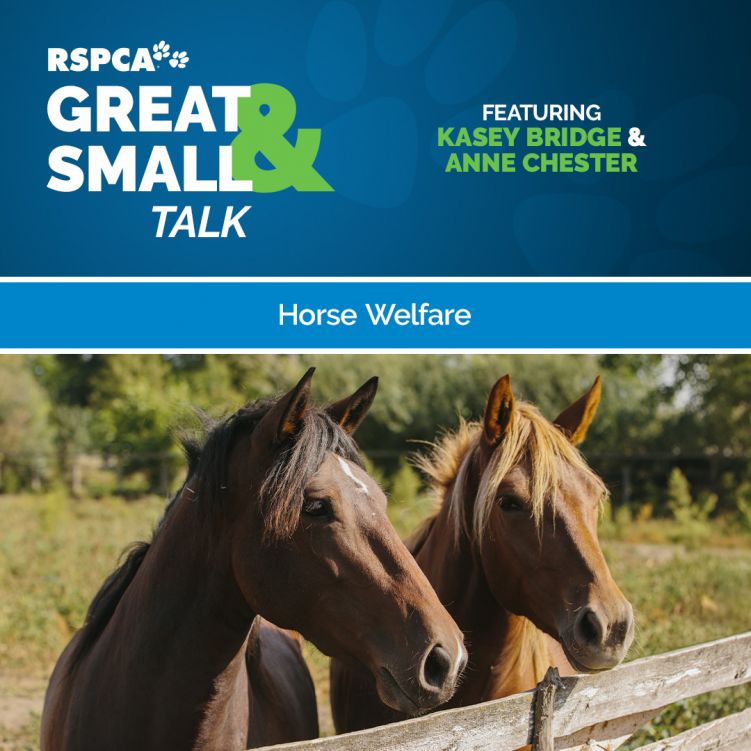
Brian: Hello, and welcome to RSPCA Australia's Great and Small Talk, where we discuss the pressing welfare issues animals face in Australia. I'm Brian Daly, and today we're talking about horses. And to find out what they need in order to live a good life, we're joined by Kasey Bridge, Senior Manager of Capacity Intake and Emergency Response at RSPCA New South Wales, and Dr Anne Chester, Senior Veterinary Ambassador at RSPCA Queensland. Kasey and Anne, welcome to the podcast.
Anne: Good morning.
Kasey: Hi Brian, how you going?
Brian: Now there is a strong bond between humans and horses that dates back millennia, and with over a million horses owned in Australia, and that's not including race horses or wild horses, that strong bond is still very much alive today. And people would want the best for their horses. So when we talk about good welfare for horses, what does that actually look like in practice beyond just food, water, and shelter?
Anne: We now talk about good welfare in animals using a what they call the five domain model, which includes sort of nutrition, physical environment, but also their health and their behavioural interactions, and then all of those have to be positive and to lead to a good mental state. So, above and beyond the nutrition and the shelter that you were mentioning, we talk about the health. People have to be able to provide, like, prompt veterinary treatment, and then they might have to consider how did they get that prompt veterinary treatment. And in Queensland, that means that the animals have to be Hendrovirus vaccinated. So there's a lot of things that go into making sure that the animals can be looked after properly: behavioural interactions, social interactions with their environment, other animals, having a positive human-animal relationship, sort of based on trust. And as I said, all that goes towards a positive mental state, and then good welfare comes from that.
Brian: Horses are seen as as strong, robust animals, but can that mean that there's a risk that some of their needs could be overlooked, so they're not as easily identifiable?
Anne: Yes.
Brian: And is that a common thing?
Anne: Well, I think both Kasey and I are looking after animals in the shelter at the moment. Horses in the shelter that the inspectors have had to seize from people that have unable to look after their animals, and also there's obviously lots of education pieces. But then there's just animals that we find in Queensland that it's often nutrition is is one of the most common things. I think people think I've got an acre, you know, or a hectare, and I can put a horse on it, and that'll be fine. And and it might be fine when the conditions are good, but when it stops raining and there's no grass, then we have to look at being able to feed them, and that's one of the main reasons our animals come into the shelter. And then there's the flip side that sometimes people overfeed their animals, and we have little fat ponies with with slippered feet, and or if they're sort of performance animals, sometimes they give them a diet that doesn't have enough fibre in it, which means that animals get gastric ulcers and therefore they're uncomfortable. So nutrition, I think, is is obviously a very important part of being able to look after a horse well.
Brian: And you mentioned previously about their mental well-being. It is very important, but that doesn't get as much attention as say the the nutrition you just mentioned. But what does good mental health look like for a horse?
Kasey: So the five domains do inform how we assess this, and looking at their mental state is a relatively new idea in horse welfare, and it is developing. But practically, good mental health in horses is characterised by a calm and relaxed demeanour, an ability to exhibit natural behaviours such as foraging and mutual grooming, and having positive social interactions with a willingness to work and interact with handlers, which allows them to adapt to different routines, and a really important thing is that they are able to be curious for new things that are presented to them in the environment and be optimistic about learning.
Brian: Yeah, I think we all like to see something new, don't stimulate us like that. So, and there's social interaction you mentioned is really important. What happens when that need isn't met?
Anne: Well, horses are herd animals. They're also so they're social animals. They're also prey animals. So they do often rely on their their friends to feel supported, and so they, if they're isolated, they can sort of become anxious, insecure, fearful, and lonely. And then, of course, sometimes we have the flip side where we have overstocking of animals, and therefore they're unable to avoid social conflict if there's too many horses in a in a in a small paddock. And then in those cases, then they start to compete or feel the need to compete for resources. So that might be food and water, or maybe even the the best tree to be under in the paddock to keep out of the the sun and the and and the rain. So yeah, so that sort of social interaction is really very important. Getting that right.
Brian: And the environment then, I guess, is really important as well. You know, the you said if there's overstocking or or not enough there, and you also mentioned about the the size of the yard, whether it's got enough food. But what about that environment? And what does that space and enrichment and turnout play in preventing stress or behavioural issues and promoting that positive experience for horses?
Kasey: So it is something that we term as the three Fs, which is friends, forage, and freedom, which are the fundamental needs of horses that, when we do meet them, contribute to their overall physical and mental well-being. So these three principles are based around what horses need as part of how they've evolved as a species. So in the wild, horses travel kilometres in a herd to forage for food, and this movement is so important to their mental well-being. If we prevent this movement from occurring, they can develop what we call stereotypic behaviours. So these behaviours are repetitive and functionless, and they do develop as a coping mechanism in response to stress, unmet needs, and confinement. If we don't allow them to have that level of movement and foraging, and also denying the ability for horses to forage can be a serious risk to the horse's health, which is what Anne mentioned before in terms of having access to a high fibre diet, which is what they require for majority of the day, is having that forage available. By providing these elements, we can create an environment that promotes the well-being of horses and prevents these undesirable behaviours, which often lead to high stress levels.
Brian: Yeah, and that stress level as well would would also cross over onto their relationships with with humans as well, and imagine if they're not in a good state, then that that relationship wouldn't be as as robust. And what what what is the key elements of a healthy ethical relationship between humans and horses that foster that positive welfare?
Anne: Well, it's obviously recognising the five domain models that we talked about for animal welfare and endeavouring to create that sort of positive mental state, but it's also important that the caregiver acknowledges that there are ongoing responsibilities for that things that they should invest in, such as ongoing education in horse behaviour, welfare handling, reflective decisions that consider the from the horse's perspective of whether they enjoy doing what they're what they're being asked to do, and obviously seeking professional advice when needed, and accepting a duty of care for the horse's lifelong welfare.
Brian: And often training practices can be either positive or negative in their impact on horses. What what should people be striving to achieve there?
Kasey: So, different training practices can absolutely affect welfare in both negative and positive ways. So, it is really important to ensure that you understand the impact of a training method before you undertake it. Modern training practices, such as equitation science, emphasise training that aligns with a horse's natural behaviours and how they learn, which promotes the positive mental state and positive outcomes, which we refer to in the five domains. So this allows the horse being trained to exhibit more positive experiences than negative. More traditional training methods tend to rely on training practices that promote the use of dominance theories, which do cause stress, fear, and pain. And in addition to this, if used incorrectly, training methods can have heavy or conflicting signals, and misunderstanding cues from handlers can lead to unwanted behaviours, which cause further stress to the horses.
Brian: And are there obvious signs that a horse is being pushed beyond limits, even if it's not obvious mistreatment?
Kasey: Absolutely. So, as Anne mentioned before, it's really important for people to have further education around horse behaviour because horses do show subtle signs of distress and pain through their facial expressions before those obvious behavioural signs become apparent. So, facial tension through the eyes and nostril are key indicators, as are the positioning of their ears. So, more apparent indicators of stress would be resistant behaviours such as bucking or rearing, or noticeable changes in temperament. Noticing the initial subtle behaviour changes, such as their facial expressions, is so important when handling horses, so that we can manage their arousal and stress levels, and control them, and keep the handler and the horse safe, and keep their welfare front of mind.
Brian: So it's really, really sounds like it's looking at a horse and really understanding its experience. And and ...
Kasey: Yeah, I think the subjective experience is really important. Like we really have to understand and appreciate how the horse feels about how you are training it, and change your training method to make sure they're having a good experience.
Brian: It sounds like a a good way to go and a and an obvious way to go, but obviously there's there's a bit of bit of a gap there to try and bridge with some owners.
Kasey: Yeah.
Brian: So for someone looking to purchase a horse, what are the most important considerations they should keep in mind?
Anne: I think it's obviously everything we've discussed being able to be up to date. With animal behaviour and being able to provide positive welfare in those five domains, I think also people really have to consider financial preparedness. Horses are expensive animals to care for, feed if if it's required when they need to get their feet done, veterinary care, and and it becomes more expensive as they get older because then they require more frequent dentals. They might require better food. They can't just be left out in a paddock. And horses live a long time. You know, 25 to 30 years is not uncommon. One of my horses lived till he was 40. So you you need to have that long-term plan for what what you're going to do. It's not just the now. And obviously, as they get older, people, you know, they they retire, and then where do where do they go and live? But if people and if people are looking to have a horse that they want to ride or compete with, then they should perhaps look at a pre-purchase vet exam to make sure that the healthy that horse is healthy and sort of fit for the purpose that they want to do, and also really make sure that there's a match for for their skill level and what the horse horse is capable of. Because if you don't have the time to commit to the training, then you might have a horse that doesn't work out for what you want to do, and then you've got the ongoing concerns about what what's going to happen with that horse. Yeah, so it's really important to have a really good think about what you're capable of and what you can manage really in in your life. Particularly if you you know if you're working or you've got family, there there is a time commitment for the horses as well.
Brian: And sounds like any any relationship with any animal that's like you need to consider all these things, but with a horse, especially as you say, they're very large animals and they need you know extra care.
Anne: Absolutely, yes.
Brian: And and you know we're talking about the the practices that compromise horse welfare before, and the positive and negative, the training and things. What what are the red or green flags to look for if to just so you know taking on a new horse. How can you avoid you know supporting practices that compromise their welfare?
Kasey: I think, as I said before, many traditional training methods are not supported by research into learning theory, and the mental state of the horse is not considered. So, a horse experiencing good welfare, as we said before, is when they are not experiencing states such as pain, fear, and distress, and they have the ability to express natural behaviours. Any practices that rely on dominance theory, fear, and punishment are outdated and ineffective. I would encourage handlers to look at modern training practices that take a horse-centered approach, which follows learning theory principles that provides an ethical, clear, and systematic approach to training horses, prioritising how they learn.
Brian: How do welfare standards differ? You know, you mentioned before about performance horses or companion horses. How does how does the standards differ depending on the type of category a horse falls into?
Anne: Well, they really shouldn't. I mean, the welfare standard should not differ in terms of the basic obligation to protect a horse from pain and suffering and injury, fear and neglect. But it's the horse's purpose, whether it's racing, working, breeding, companionship, does change its fundamental welfare needs and and the risks associated with those needs, so for example, you know, companion horse, you might have to look at whether it's getting too fat. Is it getting the socialisation that you know Kasey's been talking about? How many times is the farrier coming out, and how many times are their teeth getting looked at, and the prevention of neglect due to sort of underuse or perhaps a lack of knowledge of the owner, whereas a racehorse, you might be having to look at what's the training intensity, the track safety, the veterinary oversight, and what's its life in retirement and rehoming, and then of course working horses and competition horses. It might be competing on a on a hot day. Does the equipment fit? So the basic obligations are the same. It's just that the practical standards and management requirements will often differ because of the risk, the environment that the horse is in, and the demands placed on the horses are different.
Brian: And what legal protections exist in Australia for horses, and are they consistent across the states?
Kasey: So Australia does have legal protections for horses in place, but the laws are not completely consistent across states and territories. So currently, each state and territory has its own individual animal welfare legislation and enforcement systems, which is based around codes of practice. But the the laws are generally based on similar principles.
Brian: And do the current laws adequately reflect what we now know and understand about horses and their sentience?
Kasey: So, New South Wales laws already recognise several important principles. So, under the Prevention of Cruelty to Animals Act, owners have a legal duty of care. Cruelty and unnecessary suffering are offences, and failing to provide food, water, shelter, or treatment is illegal. Codes of practice do acknowledge that horses need exercise, social interaction, and protection from pain and disease, which do sit inside what we do know about horse welfare.
Brian: How does enforcement work in cases of neglect or cruelty, and and what are the challenges there?
Kasey: So, in New South Wales, enforcement of horse welfare laws occurs under the Prevention of Cruelty to Animals Act. So cases of neglect or cruelty are investigated by RSPCA New South Wales, New South Wales Police, or authorised officers of the DPI. So there are a few different things we could do. We can provide education to owners, issue improvement notices, seize animals, which would then subsequently result in fines or prosecutions. Some of the challenges in New South Wales we have are resourcing and funding the high cost of veterinary treatment and feed, and also adjustment with long stays due to our court process. Anne might have some comments on the Queensland process.
Anne: In Queensland, we have the Animal Care and Protection Act, where the person in charge of an animal has a duty of care to provide the animal needs, following in a way that is appropriate, such as food and water, accommodations, or living conditions. Animals must be able to display normal patterns of behaviour and the treatments and of disease or injury. And we we need to also ensure that any person handling of the animal, including any confinement or transportation of the animal by the person or caused by the person, is appropriate. But I think we still have the same problems with New South Wales. We do get animals that come into care. The inspectors do try and educate, tell the people to seek their own advice. But if they do have to come into care, they're in care for a long time because our horses are are generally older horses, generally really only suitable as companion animals, and so it's difficult to to try and find homes for those animals. And we're sort of picking up the bills that that sometimes so sometimes the dental work can be in the 1000s of dollars that these animals require to to be made comfortable.
Brian: Yeah, yeah. So again, they're they're they're very large animals, and it's not easy to rehome them necessarily.
Kasey: Yeah, sometimes they can be quite tricky to rehome them. So, and we keep them until we rehome them. But as Anne said, sometimes the older ones we have for quite a long time, which increases their cost of the having those in care.
Brian: Is there any options there for others to to alleviate that stress from you? To say foster horses and and perhaps even give them a taste of what it's like to look after a horse.
Kasey: Yeah, absolutely. We do have a foster option available for all of our animals, including horses, whereby we we supply everything that you need. I mean, you can take one of our horses into your home if you're not quite ready for horse ownership and you want to see if that's for you. Fostering a horse temporarily is a great way to do that, whilst giving a rescue horse a temporary home until we find their forever home.
Brian: Fantastic. So, if someone's concerned about a horse they see it in a in a paddock or in an event, what what steps should they take?
Anne: They can certainly report to the RSPCA cruelty hotline, and they'll be asked various questions, and then the inspectors will triage that call and proceed as as we discussed. Whether determining if it is something that needs to be acted on, talking to the owners, giving them welfare directions, and obviously, in the worst case scenario, seizing if necessary.
Brian: And we talked a lot about you know having to seize horses and and educate. And also, we're learning so much more about animals these days. What what would meaningful progress in horse welfare look like over the next 10 to 20 years?
Kasey: I think it would be increasing public awareness and public recognition of how we should keep and manage horses to meet their needs, which includes their mental state, which comes back to the principles that I spoke about before, which is the three Fs: friends, forage, and freedom, and improving the understanding and recognition of stress and its effect on training, and having an increased participation and education into ethical horse training practices across disciplines, and I also think as that's really important. But also, as we've sort of mentioned, is also the retirement and rehoming of animals as they perhaps stop competing.
Brian: Yeah, it's that long term commitment, isn't it? I think that as you mentioned, they're long lived animals and they're large animals and they need a lot of care and all of us as we age as well sort of need a little bit more care. So it's really having that long term process of I'm making this decision. It's going to be for a long time and I need to commit to it.
Kasey: Yeah, absolutely. It's so important to consider your financial situation and if you can afford the care that they require to care for them properly,
Brian: Because they are such magic creatures, really, aren't they? I mean, there is that history going back, and you see those beautiful images of that horse interaction with humans, and at its best, it's it's something quite special. That should be the the image to me that we should be should be aiming for with how we treat our horses. Absolutely. Well, thanks for joining us today, Kasey and Anne. It's been wonderful talking about horses with you. As I said, they are these beautiful creatures, and and to know how we can ensure these animals that mean so much to so many people can live their very best lives is is a really helpful discussion to be having today. So I really thank you for your time and your expertise and all your work in helping give these horses a great life.
Both: Thank you. Thank you so much.
Brian: We've been talking today with Kasey Bridge, Senior Manager of Capacity Intake and Emergency response at RSPCA New South Wales, and Dr Anne Chester, Senior Veterinary Ambassador at RSPCA Queensland. And thank you for listening. If you would like to find out more about horse welfare, you can visit RSPCA Australia's website at rspca.org.au or the RSPCA's Knowledge base at kb.rspca.org.au. You can also subscribe to the podcast series at the RSPCA website or any of your favourite podcasting platforms. I'm Brian Daly, and I look forward to your company next time on RSPCA Australia's Great and Small Talk.