Transcript
Cath: Marking out is where the rider extends their legs forward onto the shoulder area of the horse or the neck area, and they slam their spurs into the skin and muscle of the horse as it bucks. And if that's not bad enough, they then are required to drag the spurs across the skin to the shoulder repeatedly through the sequence of the buck.
Brian: Hello and welcome to RSPCA Australia's Great and Small Talk, where we discuss the pressing welfare issues animals face in Australia. I'm Brian Daly, and today we're talking about rodeos, and to help us understand the welfare risks posed to animals in the various events at rodeos. We're joined by Dr. Di Evans, veterinarian and Senior Scientific Officer at RSPCA Australia, and Dr. Cath Henshall, Animal Welfare Scientist from Southern Cross University. Di and Cath, welcome to the podcast.
Both: Thanks Brian.
Brian: And now rodeos are often promoted as celebrations of rural heritage and Australian culture. For listeners who may never have attended one, can you explain what a modern rodeo looks like? What events are typically included, and how widespread they are across Australia today?
Di: Yeah, so rodeos are held in pretty much every state and territory except the ACT, where they've been banned under animal welfare laws, and it's probably fair to say that Queensland and New South Wales would host the most rodeos across Australia. They are important for some rural communities for social networking, for bringing in much needed financial resources to the local economy, and they're important to competitors and families. Helps to give a sense of identity and connection, but we have to ask at what cost to the animals, and these are sort of human wants that being achieved at the ... at the cost of animal suffering. So there's four main time for events. You've got roping events, you've got bucking events, you've got steer wrestling, you've got barrel racing, and under animal welfare laws, you can only use horses or cattle, and if we look at roping events, calves and steers are the animals that are used for these. And this involves basically animals being chased at high speed by a rider on horseback, and then they're lassoed. So this causes an abrupt halting, and if we look at calf roping events, there are two different events. One's rope and tie. The other one's called breakaway roping, which doesn't cause abrupt halting, but it still does cause some negative welfare impacts. So, if we switch over to steer wrestling, what happens there is that a steer leaves out of a chute. There's a horse and rider. They chase the steer down. The rider jumps off, twists the neck violently on the steer to force the steer to the ground. And with barrel racing, as the name suggests, you've got a horse and rider racing at speed around three barrels, sort of formed up in a bit of a triangle sort of shape, so that they're the the main ones. But we've we're also left with bucking events. So in these, horses and bulls are used, and basically after a rider mounts the animal, there's a strap that's tightened around their body, including their sensitive underbelly as they leave the chute. And when that happens, the horse or the bull will buck wildly. It's quite extreme bucking. The feet are kicked up into the air. They twist and turn, and it's really not a natural form of bucking at all. But once that strap's removed, they will stop bucking. And the aim is for the rider to be on there for eight seconds. So if they do that, they're going to to beat the horse, so to speak, or the bull. And with the roping events, you just do it as quickly as you can.
Brian: So there's sounds like there's major welfare implications, and and there appears to be a renewed focus on attracting new attendees as marketing these as family-friendly entertainment. Why do you think this is to to regain relevance today?
Di: Yeah, look, I think it's reasonable to assume that the vast majority of Australians will never attend a rodeo, and if you compare it to a number of other sports like football, rugby, soccer, basketball, whatever, then the numbers are really comparatively very small. Having said that, there is a little bit of a rejuvenation. We're seeing Westerns being promoted, and you know Netflix series and so on. And so there's a bit of romanticising of the Western culture. But I think that in terms of relevance in today's society, it's really hard to identify this, particularly given the groundswell of concern regarding the use of animals in sport and entertainment, there is no relevance or justification for these events from the perspective of a compassionate society. Parents urge to reconsider having a family day out at the rodeo and to really think about the impact that this may have on on their children.
Brian: Because when they attend a rodeo, there's aspects of the animal's experience that might be less visible. You're talking about the straps, for instance. They might not see the animal welfare implications of that. What do they focus on, and what don't they see, I guess?
Di: So, the whole premise is man against beast, so to speak, and so the focus is often on the rider, whether it's in a bucking event or whether it's in the roping event, so commentators will be really you know providing a bit of background on ... on those competitors. So people aren't maybe looking spectators aren't maybe looking at the animals. They're often seated quite a long way from where all the action's happening. They're not ... they don't understand or they're not aware of what the telltale signs of are in fear and stress in terms of body language, facial expressions, and actual behaviours. You know things like showing the white of the eyes, mouth open, tongue hanging ... hanging out, tail swishing. You've also got bellowing in the calves, for example. Some studies we've done, we've seen ... we've seen calves bellowing quite a lot. So, and when you see these signs, it does become really clear that these animals are experiencing one or a combination of fear, pain, or stress.
Cath: Something else to be aware of is ... what happens when it goes wrong at a rodeo? It does happen. The animal gets injured, or they collapse, or they something goes wrong, and what is interesting is that the response of the rodeo staff is very well practised. They they come out, the pickup riders ride, you know, will put their horses in front of the animals so that they're not so visible to the spectators. Out come the screens, and really, what all that is about is really blocking the reality of that animal's experience from the view of the spectators, and it's sort of justified that you know watching an injured animal, you know, is distressing for the audience, but it really makes no difference to the animal's experience. And so I think it's interesting that when it does go wrong, every attempt is made to hide that reality from the people who are watching. And so I guess if we're concerned about what children are exposed to, and we are, and in the wider society, we're very concerned about what children are exposed to in social media, and we have a ban in Australia now for young people and so forth. So, in ... in that sense, it it makes sense. But the reality is, just in real time, these animals are experiencing very severe welfare impairment. That is the direct result of their participation in the event.
Brian: And when that happens, and we've got, as Di mentioned, the romanticised version of the West, the the rodeo kind of culture and ... and events. But it's important to evaluate the rodeos through an animal welfare lens rather than viewing them solely as these sporting or cultural events.
Cath: Yeah, absolutely, because we are using animals, the animals that we use in rodeos are sentient, which means they can feel. We know from affective or emotional neuroscience, cognitive neuroscience, that the brain regions for things like fear and pain and stress, as well as pleasure, positive emotions, they're very similar in human brains to animal brains. In fact, a lot of what we know about emotions in humans comes from studying animal brains. So when we're thinking about what is the welfare impacts of rodeo on animals, we need to look at the animal's perspective. And in order to understand why these particular events have a welfare impact on these animals, we need to understand what is it about these animals that are being exploited, or used or manipulated in order to get the behaviour that we see that make up the rodeo event, the bucking, the running, the bellowing, and so forth. So both horses and cattle are what we would call a social herbivore, and they are a prey species through evolution. And in fact, interestingly, with horses, there's evidence that humans have been predating on horses and eating them from the Neanderthal period, so for at least half a million years. And it is because these animals have evolved anti-predator behaviours that we then manipulate in a rodeo that it does have these welfare impacts. Because a big aspect of that is the fact that when animals in the wild, animals that are predated on perceive predators, they get frightened, and when they get frightened, they through evolution they then have a whole range of behavioural, emotional, neuroendocrine, cognitive responses to the fact that they've seen something that frightens them, and ... and what they then do is they try to resolve that by fleeing or ... or fighting, but generally fleeing. And we know in ourselves that fear is a negative emotion. Fear makes us feel bad. We want fear. We want stress. We want anxiety to stop. If we're ... if we're mentally healthy, we do things that make that happen. In a rodeo, animals are repeatedly exposed to that state, specifically to get that behavioural adaptation that you then put a rider on for a bucking, or you rope it if it's ... it's it's a calf and so forth. So we can't just; it's not like football or soccer or or other sports that humans participate in where they can consent and they choose to take those risks. In rodeo, we have an animal that doesn't consent, is exposed to these risks, and whose very welfare impairment is used as the basis for the sport.
Brian: If you were to assess the the welfare of animals used in rodeos, how would you approach that?
Cath: We know that it's not enough just to be healthy or to have a lack of obvious physical injuries. So we know that we need to consider both the mental state as well as the physical state. And as we know, say from human health, we know that people can actually have poor mental health but still be physically okay. We know that also there's an interaction between mental and physical health, and we know that those interactions can be hard to detect, but we would never say that a person in poor mental health is doing okay. So we can apply that same rationale for these animals. We look at their nutrition: are they getting you know the right things to eat to meet their needs? Then where it really ... where it really intersects with rodeo is the environment that they're experiencing, and that then feeds into the behaviour that they can perform. Can they perform the behaviour they're evolved to do? But can they also do normal behaviour and behaviour that makes them feel good? So not just resolving things like I feel hungry, I'll eat something, or I'm hot, I'll go into the shade, but behaviour that allows them to feel good as well. And so, and then on the top of that, we overlay this mental state because we know now more and more that how we feel really motivates our behaviour, and a lot of the behaviour that animals and we do is to resolve negative states and to access you know positive states. So if we think about if you ... if you're hungry or an animal's hungry, eating a tasty meal doesn't just give us nutrition. It feels good. It fires up a whole lot of our reward neurochemistry. That, and if the case of chocolate or sweets makes us eat too many, but we know it's it's how it feels. The same with if we're hot, we move into the shade. It's not just that the shade reduces our body temperature. It makes us feel less hot, and that feeling is a good thing. So that's why we need to be thinking about or looking at animal welfare holistically when we're looking at rodeo animals. It isn't just, are they injured, but what is the whole experience they have, and not just in the ring, but how they're managed getting to the event, at the event, after the event, and in between events.
Brian: Yeah. So I mean, Di, you went through the what happens in the arenas with these events: the roping and the bucking and the wrestling and the barrel racing. But you know, you mentioned there, Cath, about what happens outside the arena. What ... what are the risks and impacts to rodeo animals outside that arena?
Cath: There are many. So if we look at rodeos occur in regional areas, and particularly say in the ... the circuit in Queensland, Western New South Wales, and Northern Territory, they travel very long distances. So we're talking about 10, 12, however many hours at least, and they can actually be on a truck for I think it's 24 hours. It may be a bit less, 24 hours without a break. Now we know, and a good friend of mine's done really seminal research looking at this in horses. That long-distance transport actually causes immunological, respiratory, neuroendocrine changes and impairments of welfare that can last for up to a week afterwards. Then we look at the events the animals are kept in holding pens, which may or may not have shade, and it may be hot, and so they may not be able to resolve the fact that it's hot or it's humid and so forth. And they're generally they're kept in those pens for long periods without access to food. Now, they do feed them; they feed them overnight, they feed them in the morning. But these cattle and ... and horses are designed to graze for well, horses up to 18 hours a day, cattle up to eight hours a day. And in horses, they secrete acid in their stomachs continuously. So, if they're off food for more than a couple of hours, they can start to develop very painful gastric ulcers.
Then you've got things like the way they're handled, the fact that there's a large number in a small area, so there's not enough space to get away from if ... if one horse is or bull's aggressive to another one. Then you've got the infrastructure, the handling infrastructure, the shoots, the races. They're made of metal, they're designed to help the people handle the animals. But if the animals baulk or get frightened, they go down. They're hard to get out. They get that they can get their legs caught and so forth. And then we've got what happens afterwards, how well our injuries treated, and we're not just talking about these really catastrophic injuries that are really obvious and make the news. We're talking about localised inflammation, localised lamenesses, torn muscles, and so forth. In the ... in the equestrian horse world, those things will be really closely monitored because keeping the animals sound is really important. It would be interesting to know just how much individualised vet care is given to these animals post the event, and then of course, then we've got we're back to the transport to the next event or back to the home farm.
Brian: Coming back to in the arena, then can you tell us a little more about the serious impacts that happen in these specific events?
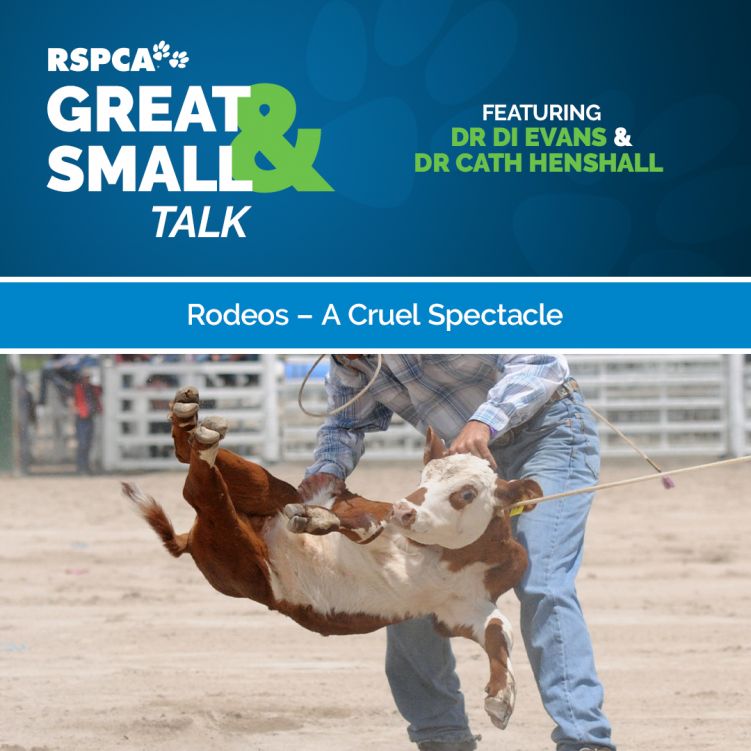
Di: Yeah, so with calf roping, these animals they're running at full pelt when they after they leave that shoot, and so when they're lassoed, they're going in one direction. Their whole body weight plus acceleration, if you like. So there's a lot of force in that one direction. When they're lassoed, they're violently jerked. Some even off their feet completely. But what I did want to point out is the pressure that's put on the windpipe, and you only need to lightly touch your own windpipe to know how sensitive that area is, and we need to remember that these calves are enduring this time and time again, not just at the rodeo event, but in training sessions as well. It is relentless. So this is a really, really big issue for ... for the calf roping. In terms of barrel racing, which doesn't really get a lot of sort of airplay, there are a lot of welfare risks, and many of which aren't unique to rodeo or barrel racing, but will be seen in horses that are competing in other equestrian events and things like what Cath has mentioned, you know, muscle strains, ligament strains, other causes of lameness. But the other, there's been a couple of studies, one in Canada which really showed how prevalent barrel racing horses are to bleeding in the lungs, and this is being picked up more and more, and it's associated with thoughts that it's really due to stress, if you like, in the lungs, and ... and this is because barrel racing is an explosive sort of event. It's very high intensity, and so it's putting a lot of of stress on those lungs. And the other condition, a more recent study done in Texas has picked up that barrel racing horses are prone to coughing, asthma, as well as this bleeding into the lungs, so there's some big issues there.
Brian: And what about the other events, Cath? The bucking and so on.
Cath: The welfare issues in relation to the bucking events are consistently very negative for the for the animal. So if we start with what drives the bucking, which Di has already mentioned, that is the flank strap or the flank rope, it is tightened around the animal's abdomen, including, as Di mentioned, the sensitive underbelly, where the skin is actually quite a bit thinner than other areas of the animal. And as the strap is attached, and then as the animal leaves the chute, it is tightened. And you can see that if you watch videos or you watch the event, some animals will be a bit calm, and then as soon as that chute opens, they are explosively bucking. And, as Di mentioned, the kind of bucking that we see is far more extreme than anything we would see in the wild, or even generally when horses are trying to dislodge a rider. And I've watched a lot of those videos, and I have also ridden horses that buck. And yeah, that kind of bucking that the dislodge as a rider is nowhere near as violent, is nowhere near as extreme in terms of the hyperextension and hyperflexion of the relevant joints.
So the other issue is that that bucking goes on for far longer than most horses, even horses that are playing in a field or bulls or calves or you know steers that might be having a play in a paddock. The duration of the bucking is far greater in a rodeo, and the reason for that is because that strap is eliciting that response. So that's a physical component. If we then add the reason that that strap is eliciting that response, bucking like that is what we in the animal behaviour area call an an extreme anti-predator response. It's the kind of last resort you do when something's trying to kill you because it's very risky. It's energetically demanding, but it's also risky because if you land awkwardly, you can then you can fall and then it's game over for you. So it's the last resort, and it is elicited by those extreme fear responses. And in fact, when animals are panicking, just like us, they're not in a position to make good decisions. They are just relying on those hardwired genetic behavioural repertoires, which is get me out of here. Which means what then can happen, and we see it, is they then collide. They collide with the structures around the arena. They might collide with the the pickup horses and so forth. None of these are behaviours that any any rational, any sensible horse or bull would ever choose to do. They're only doing them because they're in that state of extreme fear.
The other aspect which people may not be so aware of, which is also very significant welfare impairment issues, is what's called marking out. So marking out is actually a requirement of the sport in order to get a scoreable ride, you need to demonstrate marking out. Marking out is where the rider extends their legs forward onto the shoulder area of the horse or the neck area, and they slam their spurs into the skin and muscle of the horse as it bucks. And if that's not bad enough, they then are required to drag the spurs across the skin to the shoulder, and then they are required to do that repeatedly through the sequence of the buck. So as the horse lands, they do it again. So the spurs are not sharp like a knife, but they are allowed to be pointed. So they have a point, and if you watch and you can see on social media, slow motion. Video of marking out, you can see the ends of the spurs disappearing into the skin of the horse, and you can see them dragging and deforming the skin as the horse moves. There is zero reason to ever do this to any horse in any ridden situation, and the problem for horses is they generally have dark skin, so we can't see the bruising and the localised inflammation that will be happening as a result ... as a result of that. The bucking and the marking out are two critical elements of the ride, how you ride a bull or a horse, but they have substantial welfare impacts.
Brian: It sounds terrible. I'm just wondering how, with the you know animal welfare legislation that's around that supposed to protect animals from harm or distress, how is it that rodeos are able to continue these practices, and how much actual oversight is provided that the events ... independent oversight from the from the industry itself, for instance. You know how how is this able to continue?
Di: Yeah, no, it's a really good question, and I think for most people they think if something is legal, then it doesn't involve animal cruelty. But nothing could be further from the truth in relation to rodeos. Our laws are not sufficiently strong enough to protect these animals. And in fact, in most jurisdictions, operators and competitors are protected from being prosecuted under animal welfare legislation. And you ask, how can this be? It's ... it's incredible to think that these laws are actually protecting the perpetrators of animal abuse and not protecting the animals from harm, which is what animal welfare legislation is designed to do. That is its purpose. That is its intent. And the reason that the humans that are involved are protected is because there are exemptions and clauses that basically give legal permission for animals to be treated in this way. So to host a rodeo to have these events is legal, and everything that goes along with that. As mentioned before, ACT banned rodeo in 1992, and Victoria and South Australia have effectively banned calf roping, which is great, and the RSPCA wants to see the end of all of these events, but particularly calf roping because it involves such young animals, and the impacts on these animals are just extreme. And in terms of oversight, well, monitoring and enforcement are absolutely integral. You can have the best welfare laws in the world, but if people aren't out there actually watching what's going on and holding people to account and investigating, taking evidence, and prosecuting, then there is no deterrent. So the problem you've got is that regulators, you know, animal welfare inspectors, under resourced. You've also got these events being held in regional and often remote areas, so that's going to be a barrier to monitoring. And in effect, animals are being let down in in two ways: the laws are weak, and nobody's even checking minimal standards. So, yeah.
Cath: And can I just add something there? That other equestrian events, say racing, and certainly some other events where there's a higher risk, say eventing, which is a sport where people they do dressage and then they ride horses at speed over fixed obstacles at a cross country course, and because they're fixed, if the horse falls, it can that can lead to the death of the horse and the rider. It's mandatory to have vets in attendance and vets with experience in treating the animal species, whereas, as far as I'm aware, in the codes of practice for rodeo, there's a requirement that a vet is available, but not necessarily that the vet isn't in attendance. And as we know, in racing, particularly for the marquee events like the Melbourne Cup, there's now very strict requirements in ensuring that the animals are fit to compete, and they will be withdrawn if they are deemed not fit to compete. Whereas there's none of that oversight of animals that are going to be used for these events, despite the fact that the physical impact on them is ... is in the in the same extreme sort of level as it's going to be for ... for racehorses.
Di: It is mandatory for vets to attend in a couple of jurisdictions. It's also recommended or should in some of the rodeo rules as well, but it needs to be mandated across all jurisdictions. And the other thing is not just about vets having the power to withdraw animals who are unfit and shouldn't, you know, be used in that event. But while they are, the vets need to focus not just on physical injury but mental impacts, and this is such a deficient area. So, particularly when animals are in the chute waiting to go, the vet should be there, absolutely scrutinising every single sign that might indicate that that animal is really distressed, or even before they get really distressed. But even at an earlier point than that, and remove those animals that they are not fit to be used for competition. The other issue is reporting in Victoria and New Zealand. It is mandatory for vets to submit a report to the government regulator. That should be another requirement across all jurisdictions. And we need to get vets who are independent of the industry, that they are not being coerced or influenced, but they are there first and foremost for the animals. That's their job.
Brian: I think you touched on Cath about we protect children from many things these days, but encouraging children to see these animals being chased and put into these situations as entertainment, and even encouraging children to participate in these events. How would this affect their attitudes to respect, for empathy, all those things that we hope that our ... our children grow up and our society grows these aspects of treating others well, not just other people, but other other species as well.
Di: Yeah, look, I ... I think with this there's a disconnect with rodeo. I think one of the biggest challenges is for rodeo to accept and to recognise what's really truly happening to these animals. And because you know we've got tradition, we've got culture. They've been doing it for so long. They don't see what's happening to these animals. And look, I'm sure that many of them do love animals in other contexts, but not those animals that are being subjected to this treatment. So it's quite a dilemma, really, when you think about it. How you can do something to an animal in one situation, but you wouldn't consider it okay in another situation, I mean, some people have likened roping calves to roping dogs. You know, they can run fast. Some of them, bigger dogs are, you know, are getting up there in terms of size and so on. But you would never consider doing that to a dog. So why is it okay to do it to a calf?
The other thing, I guess, with the physical impacts is that we're seeing more and more children being encouraged to participate, and including things like jumping on the back of sheep or potty calves or even ponies and kicking them while adults are standing around slapping these animals, pulling tails. It's abhorrent that this is going on. Children as young as seven. Actually, some of them are probably doing it even younger than that. But I really feel for these children because they are being forced into a situation that they don't actually have a lot of control over, and they are very much influenced by their parents and want to please them, as well as peers. And so, you know, they're getting pressure to do these things, and they're very dangerous activities. So we know that with bucking events, there's a serious risk of concussive brain injury. And you, you know, you think about it. This the head and neck is going backwards and forwards consistently, and time and time again, it's just beginning to be recognised in the US as well as Australia, mainly in adults. But there are cases in Australia with teenagers who, well, at least one case where a teenage girl who's been involved in a lot of bucking events and on medical advice, she's basically been told if you continue, there's a risk that you might die. So that's how much pressure these kids have, and ... and I think they get bitten by the bug too. To be honest, because of all the hype and the you know the the sort of glitz and glamour that can go with it as well. So yeah, it's it's a huge thing to ... it's a big package of stuff there for kids. Not good stuff.
Cath: No, and what's interesting is someone who used to teach kids how to ride is that certainly kids that are coming to you know ride ponies, they're there because they love the horses, they want to be with them, and quite often they'll get on the pony and and the pony won't be responding the way that the child would like because the pony's been around a bit, and so the the thing you say as a riding instructor is is basically use more force, kick kick the pony. You might give the child a a whip, and you'd say tap the pony. Or if the pony's not responding, you pull on the reins harder. Most kids generally they don't want to do that, because they love these animals and they don't want to hurt them. And what they'll say is, I don't want to hurt. Does it hurt? And as a writing instructor, I would say because I was socialised into that earlier on. No, it doesn't hurt them. They're a big animal, you know, and and so on and so forth. So we as adults, we take that kind of empathy for animals and we twist it, or we tell the kids to disregard it. Well, rodeo does that on a hyper scale because it's not just getting a pony to to walk or trot. It's about laughing, joking, celebrating animals behaving in the panic, the fear, the terror behaviour.
Di: And if I could just add to that quickly, again, like Cath, I've watched hundreds of videos, and the two instances I recollect because I had the sound on, the video was obviously being taken by spectator in the crowd. A little child said to their mother when a calf was coming out of the chute and struggling to get away. He, the little voice, said, "Look, mummy, he's trying to get away," as if it was funny. And another instance was where a child said to their mother when the lasso went and they were, you know, pulled off their feet. "Mum, doesn't that hurt?" And she goes, "No, they don't feel it." So it's, you know, I couldn't believe my ears when I heard that. It just, it was, yeah, beyond belief. So...
Brian: And people would think that these rodeos reflect the extremes of what happens in everyday farming activities and what people do on their farms, but that's not really accurate, is it?
Di: Not at all. Rodeo doesn't reflect modern or good farming practice, and the livestock industry goes to great lengths to promote handling of animals in a calm and gentle manner, and this is essential not just for good productivity. It's good for welfare and it's good for human safety. So, low stress stock handling principles and practices are promoted by the rural industry, whereas with rodeo, rodeo just completely contradicts these chasing, kicking, choking, placing animals in a noisy, crowded environment doesn't occur on farms or pastoral stations where there are good husbandry practices.
Cath: I guess the other issues, if you look at bull riding and steer wrestling, there's no there's no rationale for doing that. It just makes the animals hard to handle and unsafe. And the same with our bucking horses. The tradition of riding your bucking horse is that that's in the past how horses were broken in, you got on them and they you bucked them out. But the equitation science, the the horse world has moved on from that, and we now know there's a good reason for that because horses which learn to buck their riders off, then they can do it into the future, even with extensive retraining. So just like with livestock handling, good horse training is all about minimising fear behaviour, minimising stress behaviour, not deliberately inducing it.
Di: And one of the problems with that is by eliciting this bucking behaviour, it's difficult to know what happens to these horses after they're used in the rodeo industry. Where do they go? Do they have a life after rodeo as a recreation or companion horse, we ... we actually don't know. The racing industry is being held accountable in terms of the fate of ex-racehorses. The rodeo industry needs to be open and transparent about the fate of these particular horses, and it's not just about where they go, but what injuries are they carrying as well? You know, are they in constant chronic pain? Have they got conditions that are really challenging to resolve? There's a lot of questions about about this.
Brian: Is there any way that a rodeo can be safe for animals?
Di: Look, rodeo events have changed very little, probably over the last century, and this is one of the reasons why they don't meet community expectations, where we know there's an increasing level of empathy and compassion in the community. The community's changed. Rodeos haven't. They have not moved on. They've tinkered around the edges, you might say, and they've made attempts. But you cannot resolve the inherent animal welfare risks that are associated with these events. For example, you know the flank strap has to be certain specifications, including being fleece lined and and all of those sorts of things. That's not going to stop all of the reactivity that these horses have and the fear and the stress that they're experiencing once that strap's tightened. With calf roping, they've introduced a device called roper's mate, and there is no evidence that this does really act as a shock absorber in a live animal. They've done some desktop assessments. That's not good enough, and it doesn't address the chasing, the actual choking, and the throwing to the ground. So it's virtually useless in terms of trying to resolve some of these issues. So, yeah, it can't be made safe. I think that's the simple answer.
Cath: It can't be because it's relying on fear, panic responses in animals, and without the fear, without the panic, you you don't have the events. Other than the barrel racing, you don't have the events. So it is structural. It is built into the very fabric of the activity and what is celebrated about it.
Brian: Because we've moved on in in cases of circuses and marine parks, as you said, died. The community's moved on in these areas, and we should be looking at rodeos in the same same framework.
Di: Absolutely, yeah.
Cath: So I guess the first thing to note is just because the animal is a bucking bull, or it's a even a bucking bred horse, it's still a horse. It's still a cow. It's still a bovine. So what it feels, what it experiences, is no different just because of the use that it's put to. So there's no rationale for applying a different set of welfare standards, health standards, whatever any kind of standard, because it's used as a bucking animal or a calf for roping versus in a livestock production system. And I think we have recognised, we've rightly recognised for marine parks, and racing is slowly being brought into this conversation about the welfare impacts of these activities and circuses. And you know, historically in rodeo, they talk a lot about tradition and culture. Now, a lot of the culture is American, and from America actually came from Mexico. So, how ... how cultural is it? But it's they're embedded in culture in Australia now. But you know, bullfighting or or dogfighting, cockfighting. These were also activities that happened in say New South Wales. Now we've recognised as a society that it's unacceptable to cause that level of harm to animals simply for the purposes of entertainment. So, and we recognise it. It's not okay to put intelligent species like dolphins in small marine parks. I mean that it still happens, but there's concerns about that. We recognise that the life of a travelling animal, a tiger or an elephant, and so forth, their needs can never be met in a circus, and the training methods used to get them to be to perform are unacceptable. So we we've already, as a society, gone down that journey, and we've understood those things. So there's no reason why exactly the same standards that led us to think that animals and circuses was a problem can lead us to to the same conclusion that the way we use animals in rodeos is unacceptable. It cannot meet animals' needs, and it exposes them to these these welfare impairments, both physical but also those mental aspects, and we can't ... when we look at animal welfare, we have to take into account those mental aspects because they are what give the welfare its felt quality, and they they are what the animal experiences.
Brian: Well it sounds to me like the future's clear that these events at rodeos need to be reassessed completely? What's the RSPCA's take on this, Di?
Di: So for decades, the RSPCA has opposed rodeos due to all of these inherent risks of pain, injury, stress, and fear. And to this end, the RSPCA urges governments to ban rodeos, as it has happened in the ACT over 30 years ago. If that's not possible in the short term, then to at least prohibit calf roping or the use of calves at all at rodeos across all jurisdiction. Again, we have a precedent in Victoria and South Australia. We urge people to reconsider attending rodeos, as to do so is enabling animal suffering. We urge sponsors to stop supporting rodeos because this promotes rodeos and promotes animal harm, and we urge rural communities to find alternative forms of entertainment that doesn't involve animal suffering. I think, put simply, there is no place for rodeo in a modern, compassionate society.
Brian: Thanks very much for joining us today, both of you, Cath and Di. I find it really helpful to hear about these welfare issues associated with rodeos and how they've somehow become normalised in these settings, where outside of these settings, you know, they would be clearly and correctly seen as totally unacceptable treatment of animals. So let's ... let's hope we do see some changes here and and an agreement, as you say, that sport or entertainment should never involve animal cruelty. So thanks again for joining us.
Di: Yeah, thank you.
Cath: Thank you.
Brian: We've been talking today with Dr. Di Evans, veterinarian and senior scientific officer at RSPCA Australia, and Dr. Cath Henshall, Animal Welfare Scientist from Southern Cross University. And thank you for listening. If you would like to find out more about the animal welfare issues associated with rodeos, you can visit RSPCA Australia's website at rspca.org.au or the RSPCA's Knowledgebase at kb.rspca.org.au. You can also subscribe to the podcast series at the RSPCA website or any of your favourite podcasting platforms. I'm Brian Daly, and I look forward to your company next time on RSPCA Australia's Great and Small Talk.